
Wolwekraal Nature Reserve
Newsletter, Issue 5, September 2026
Welcome!
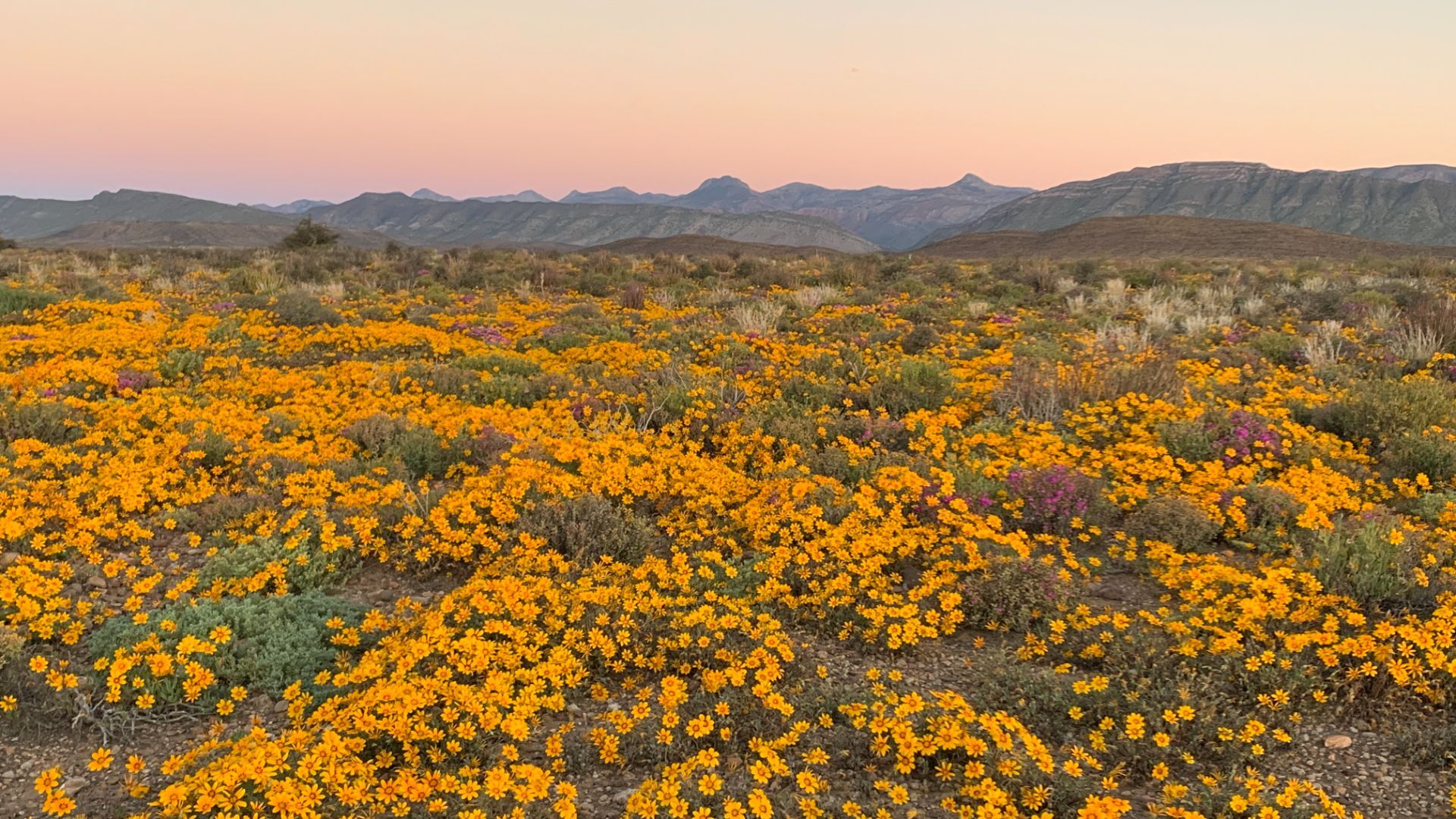
Our fifth issue of the Wolwekraal Nature Reserve newsletter arrives from a flower-filled veld in the Prince Albert area! The high Autumn rainfall we experienced, and current warm temperatures have brought on an early Spring, and an exceptional flowering season! WCRO has some exciting new projects, including the building of a bird hide on the reserve, and some interesting talks and events at our Research and Education Centre.
Highlights from the Reserve
Conditions
The annual rainfall total to date is 220mm on Wolwekraal Nature Reserve north, 231mm at Wolwekraal Nature Reserve south, and 313mm in town.
On the reserve we recorded 36.5mm rain in June, 0mm in July, and 2mm in August. The Dorpsriver has flowed strongly since 6 May, and it increased in volume following the snowfall on 8th August on the Swartberg.
Soils remained damp, morning dews were heavy, fog occurred on about five days, and atmospheric humidity exceeded 70% throughout June and July.
Plants and Animals
Annual plants are abundant and flowering, however some succulent populations, particularly local endemics (Lithops, Bijlia, Glottiphyllum), Malephoropsis, and various Mesembryanthemum and Ruschia species have suffered considerable dieback (20% to 50%) caused by moisture-induced fungal attack and rotting.
Kori Bustard, Caracal and Aardvark have been recorded on the reserve every month. Spike-heeled Lark, Rufous-eared Warblers and other birds are breeding.
Problem Porcupines
Porcupines are now feeding mainly on geophytes, particularly Moraea speciosa, Cyperus usitatus and Oxalis.
Reptile Release
Because of cooler winter conditions, there have been very few reptile relocations over the last three months: 8 Brown House Snakes, and 1 Horned Adder.
Below is a photo supplied by Athol Loppnow of the Horned Adder before release:
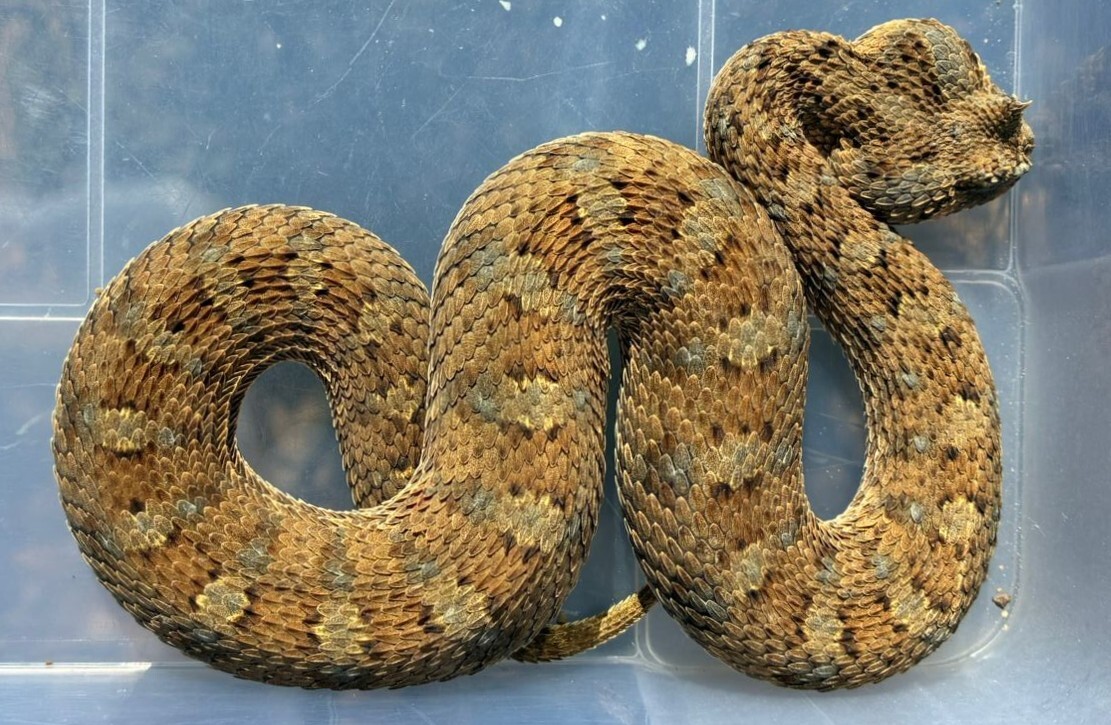
*Reptile relocation and release helps address human-reptile conflicts, such as when a snake is found in a residential area or poses a potential threat to people or pets, or to protect a reptile from harm or potential persecution. Capturing and relocating reptiles must be done with a licence, and with the goal of peacefully mitigating immediate human-wildlife conflict while providing long-term sustainable alternatives. In the Prince Albert area, resident Athol Loppnow is registered to relocate reptiles, which he releases into a safe environment on Wolwekraal Nature Reserve.
Education and Awareness
Research and Education Centre Events
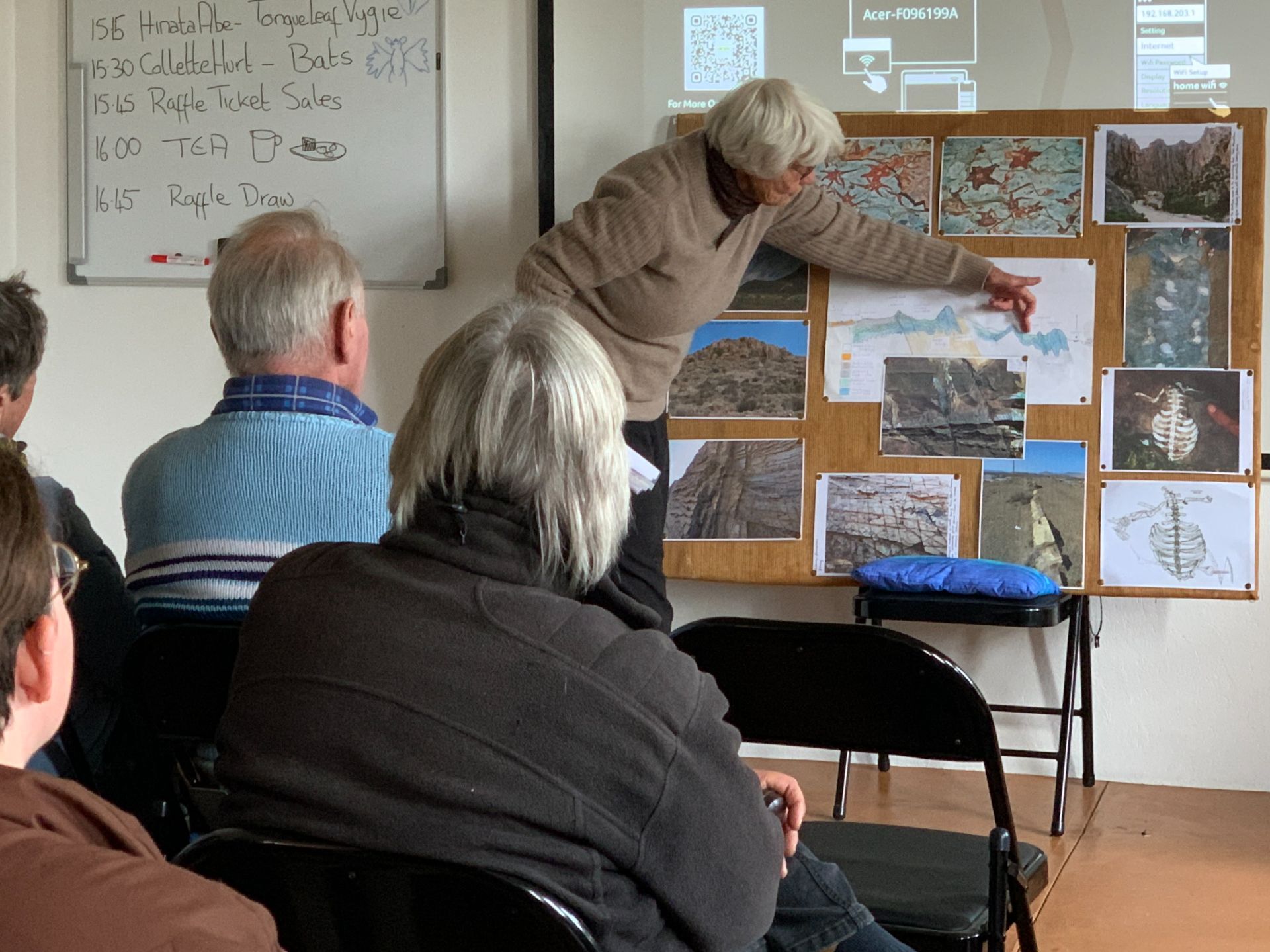
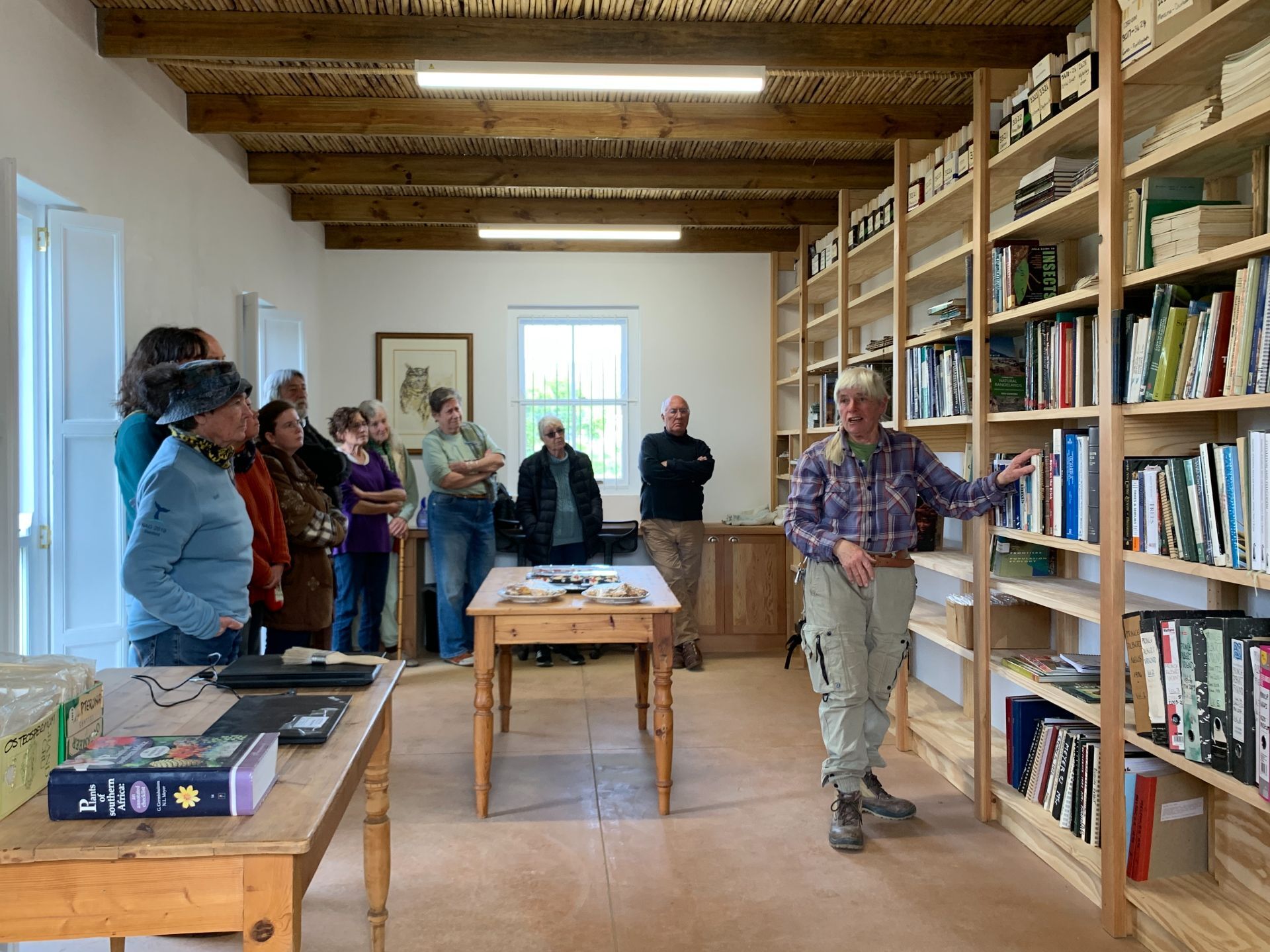
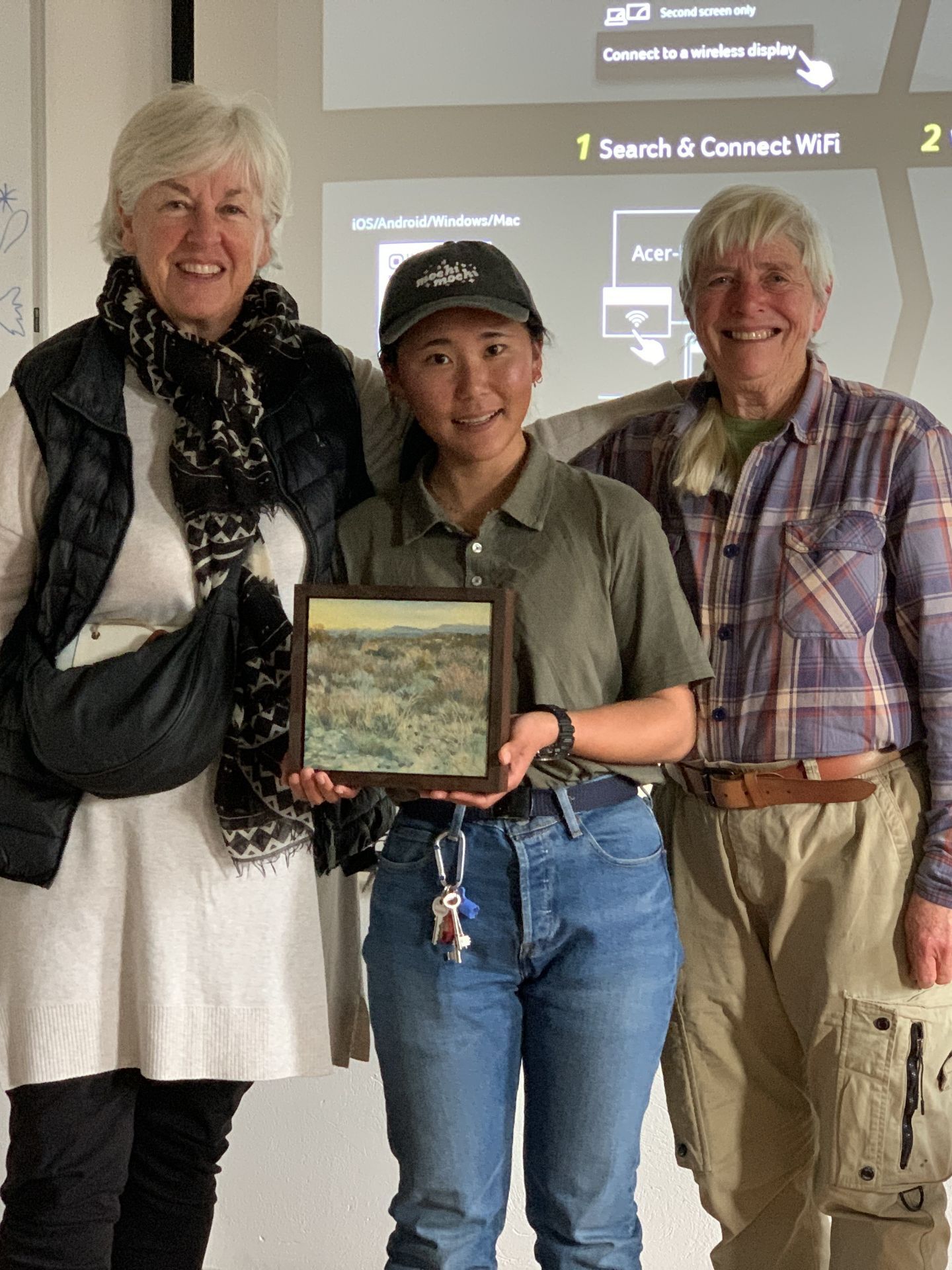
On Mandela Day, Saturday 18th July, we held a show-and-tell event to display the scope the WCROs work. It featured short talks on geology (Dr Judy Maguire), bats (Collette Hurt), tongue-leaf vygie (Hinata Abe), the indigenous gardens around the building (Bertus Fourie), and a demonstration of medicinal plant teas used by the local community (Meraai Isaacs). This was followed by the raffle draw for Lisl Barry's original painting of Wolwekraal at sunrise, which she donated to raise funds for the Research Centre. The raffle of this work raised R5,200, and was won by Nel Kruger who then donated the painting back to WCRO for display in the Research Centre! Many thanks to Lisl Barry, Nel Kruger, and to all those who bought raffle tickets!
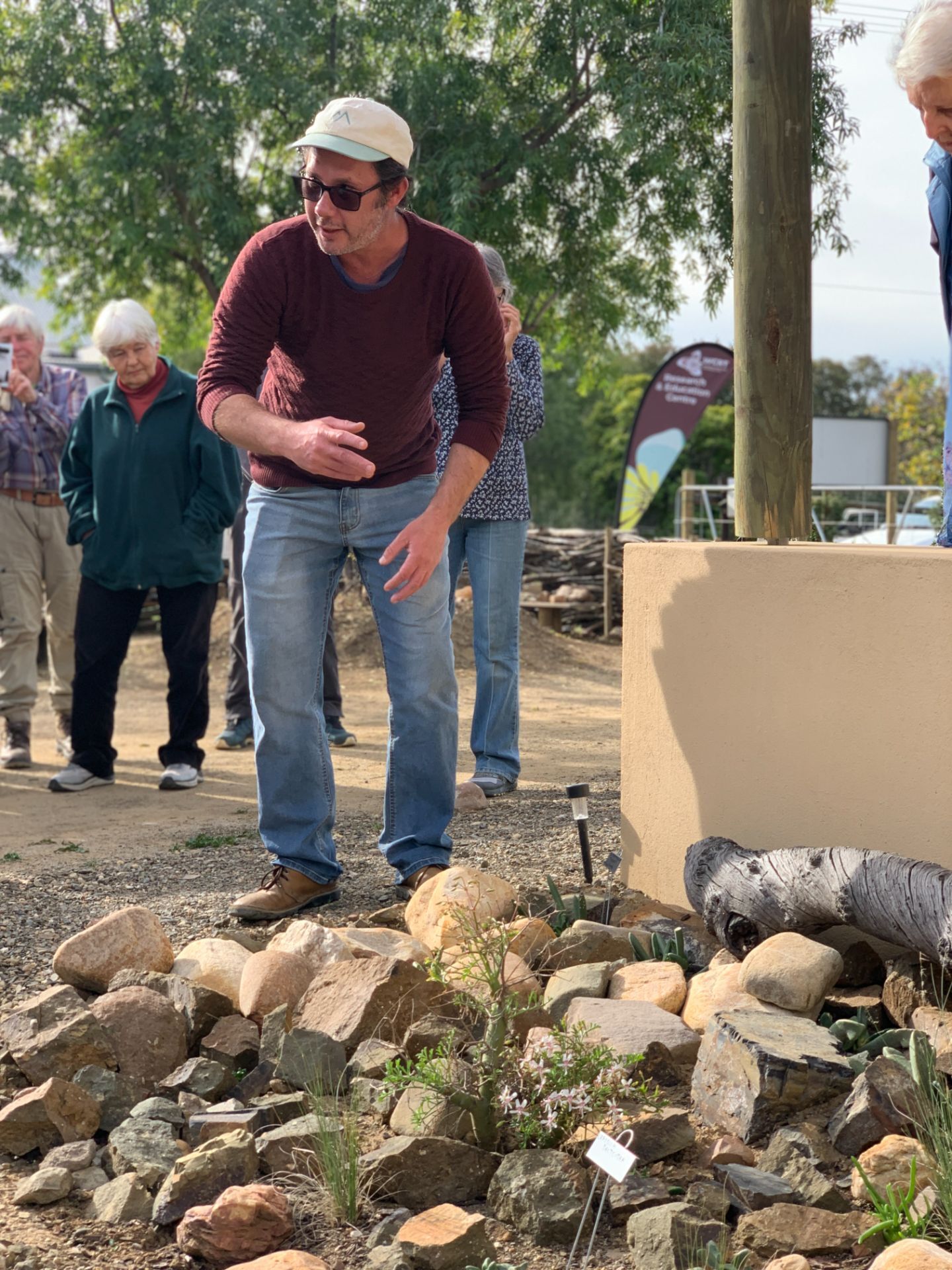
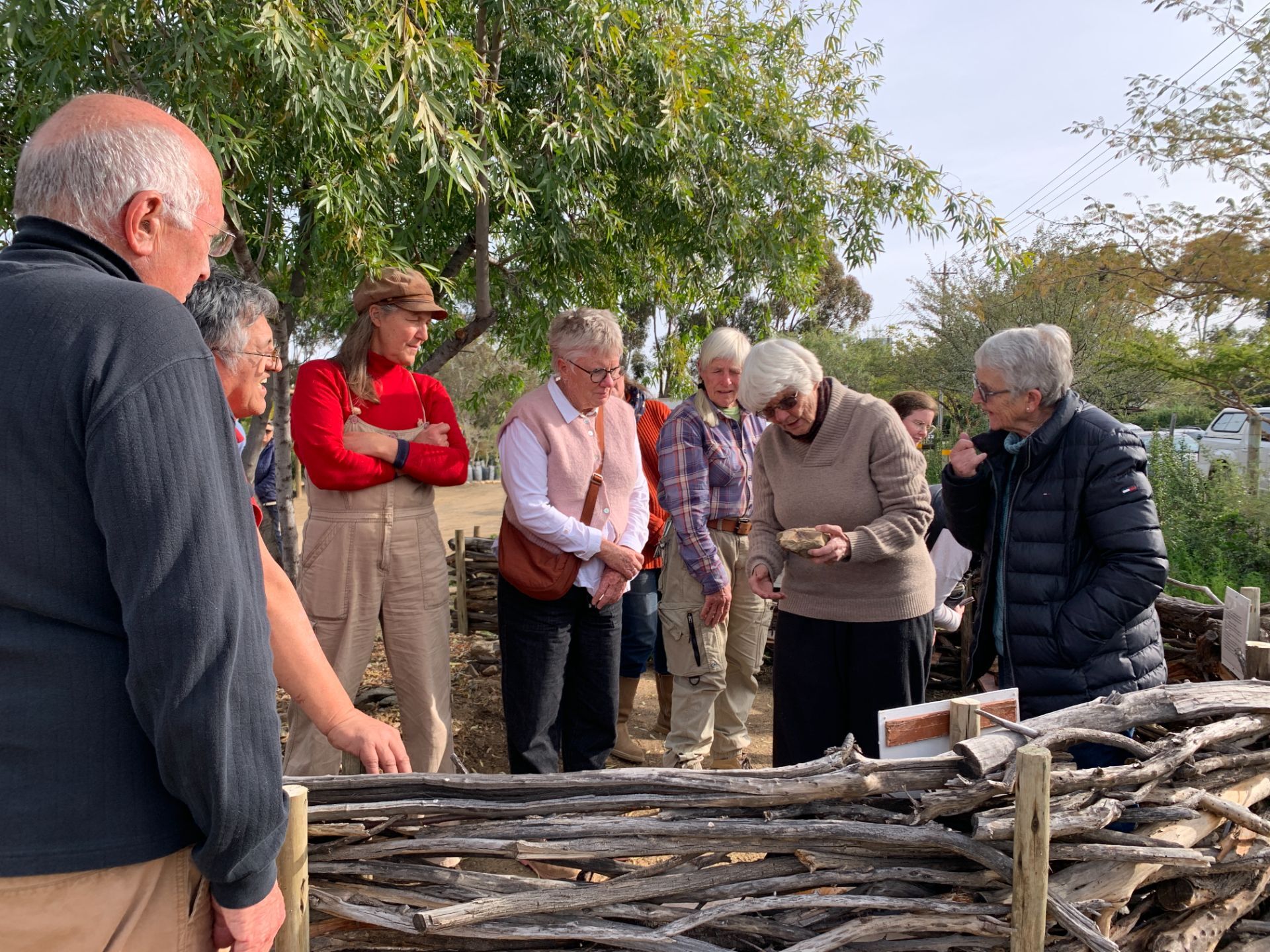
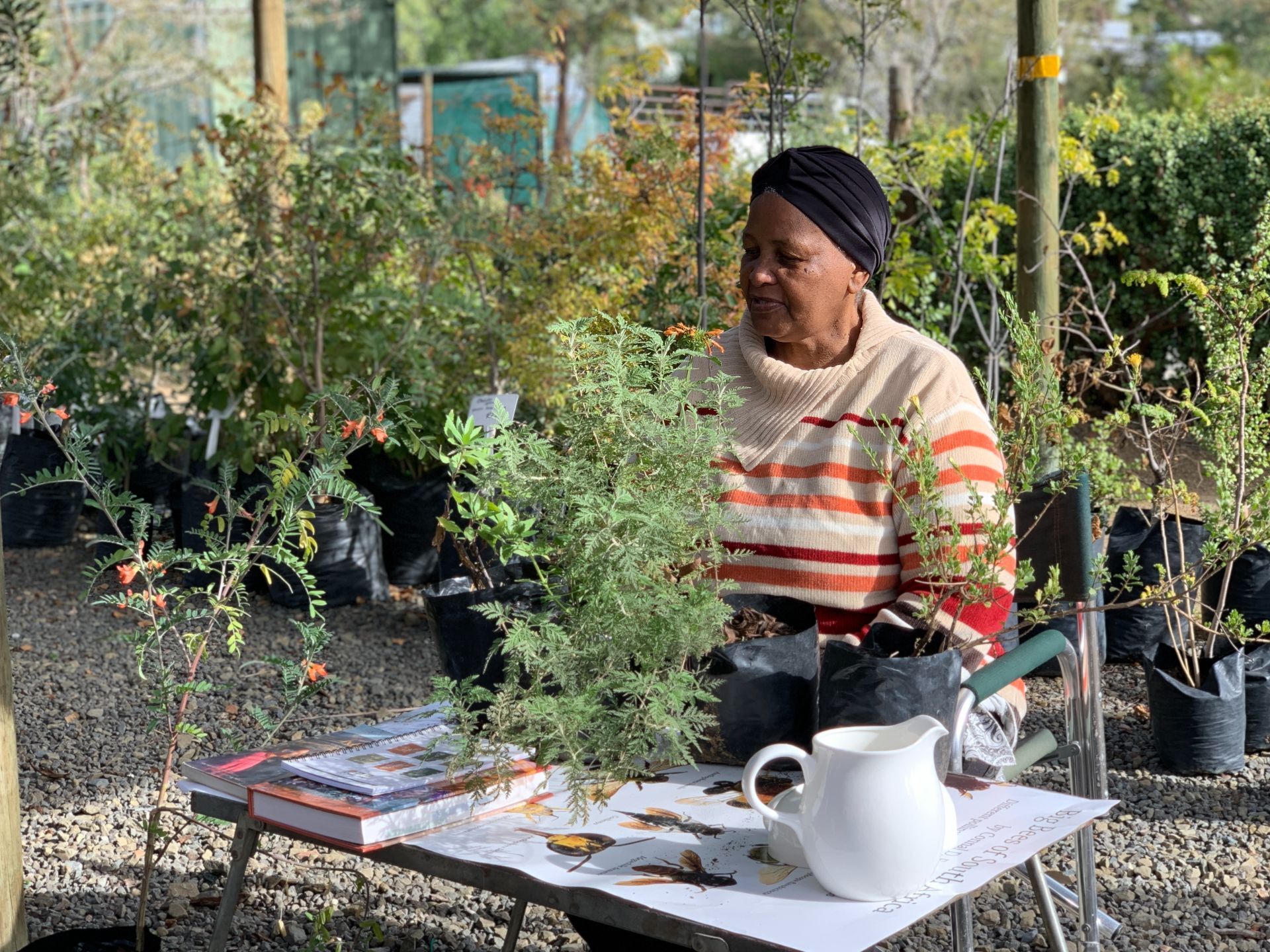
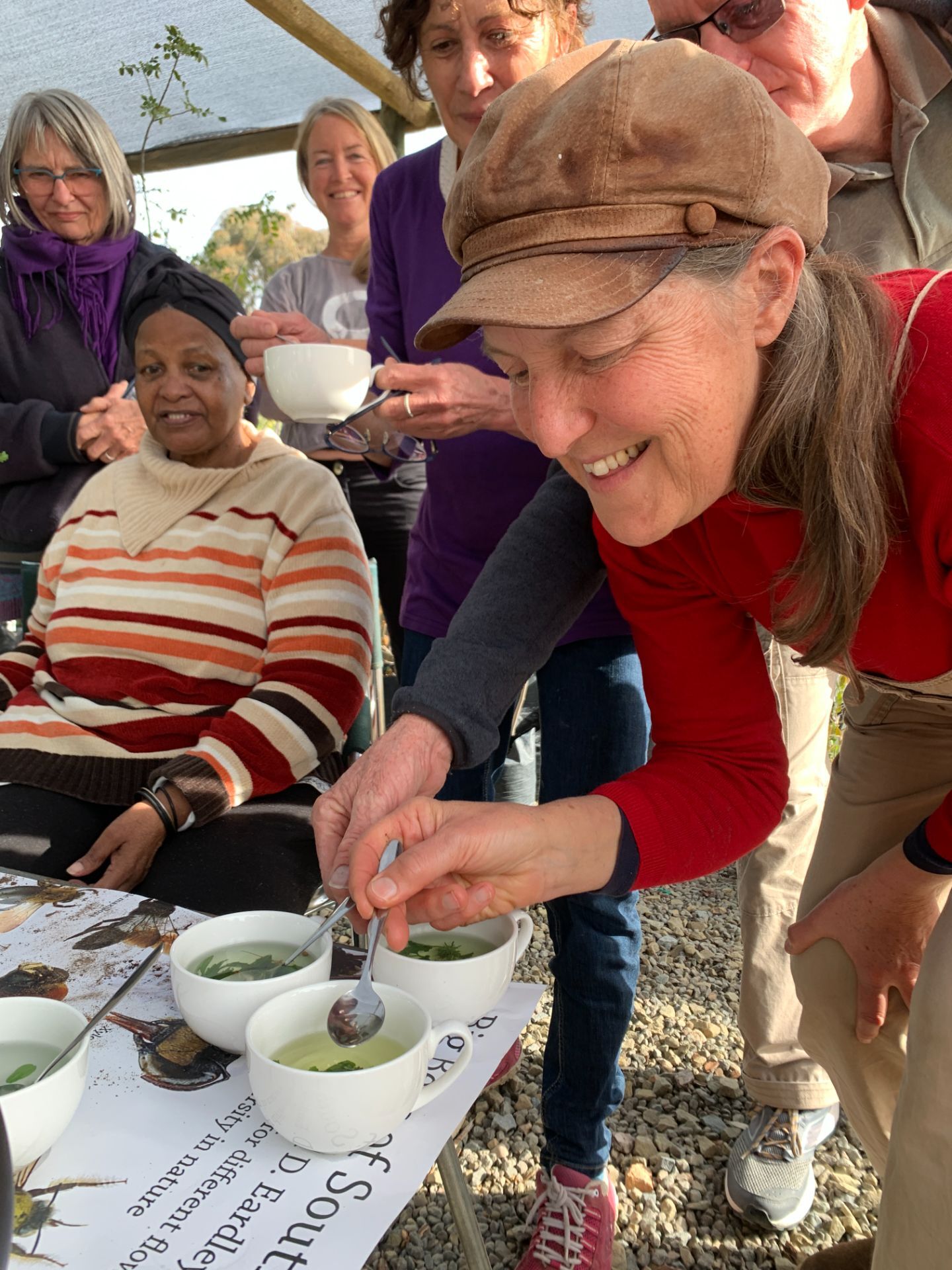
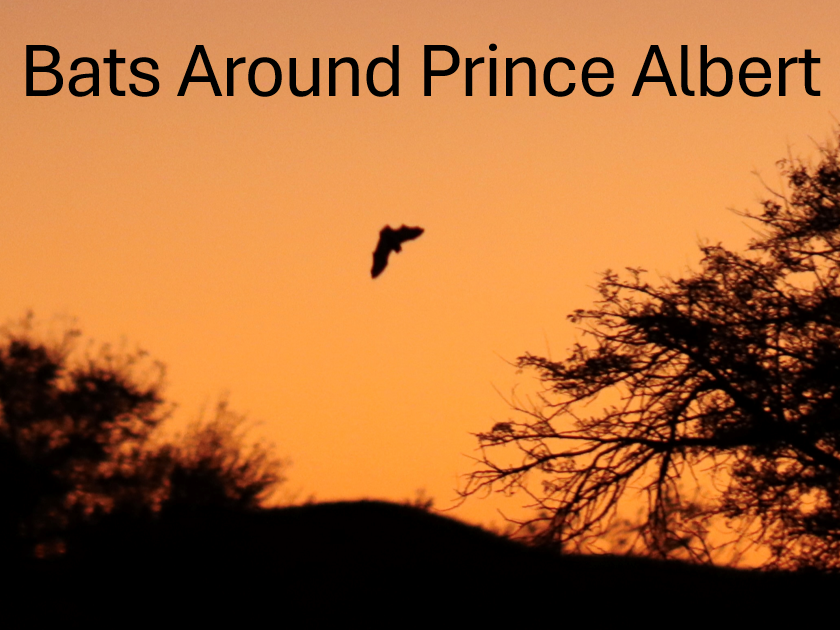
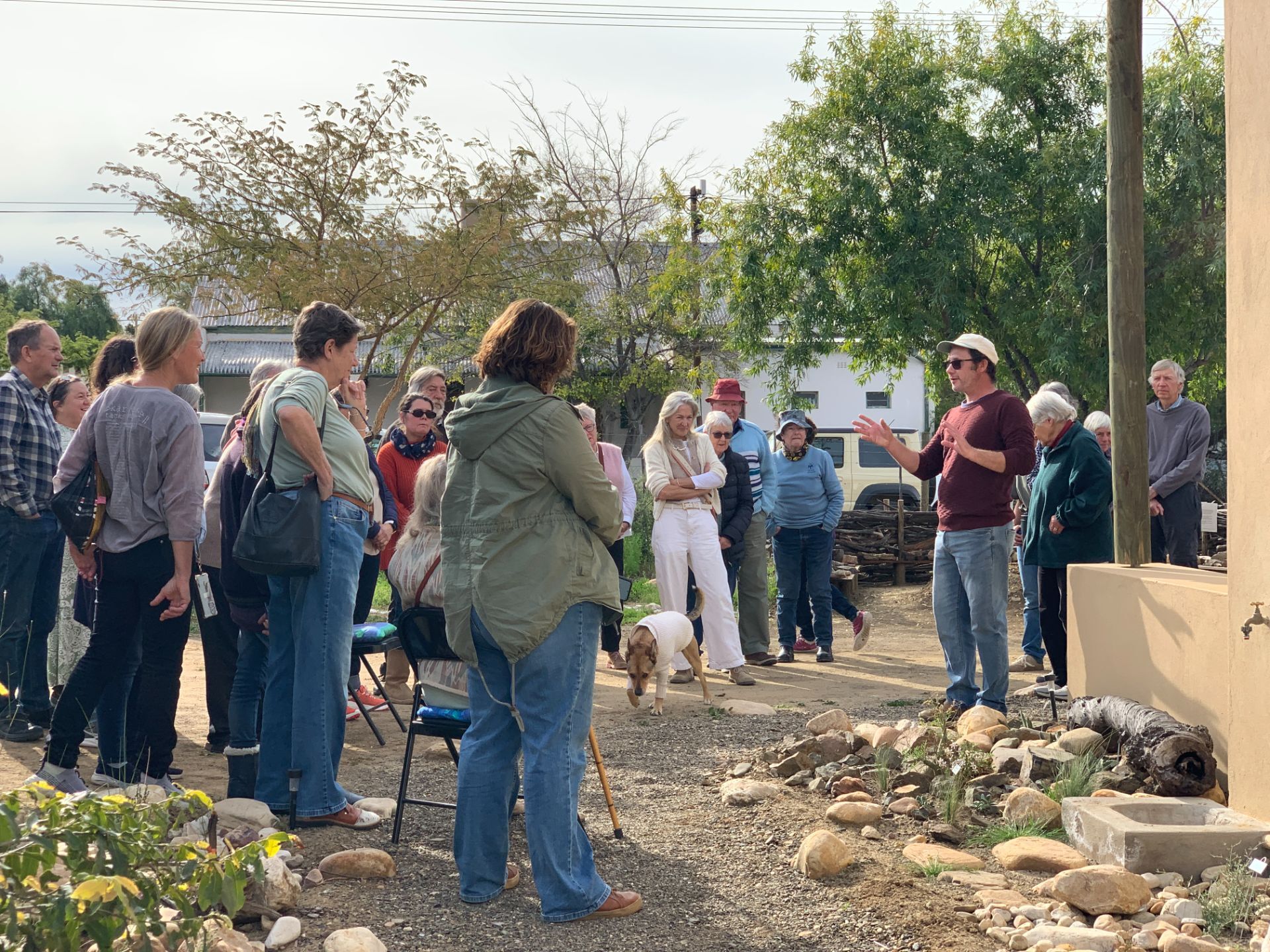
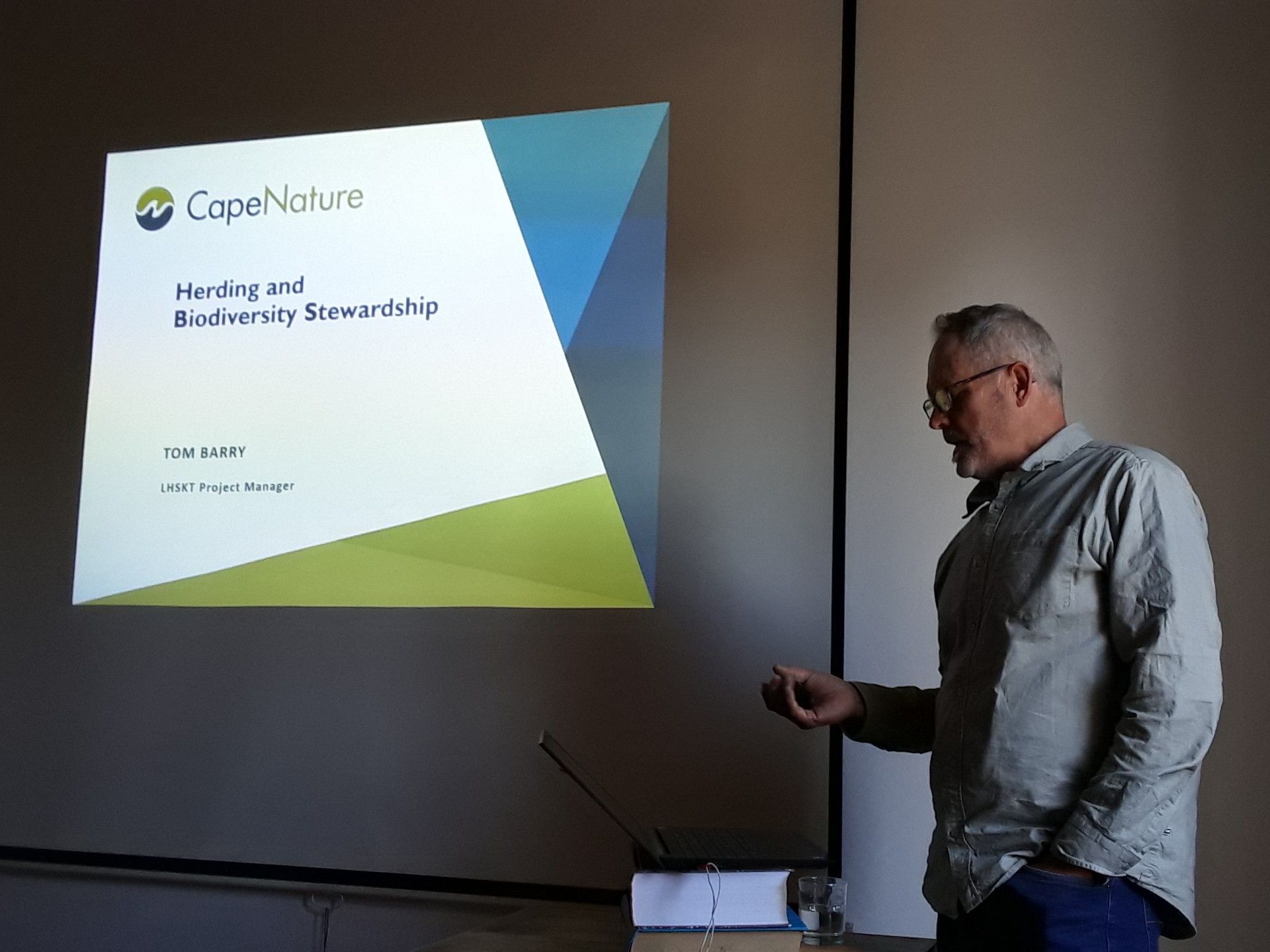
On 15th August we held a farmers’ day featuring a talk on conservation stewardship by Tom Barry and a mini bossiedag – a plant identification and grazing value participatory excursion on Gordon Koppie led by Sue Dean, Bertus Fourie, and Rudi Swart from the Worcester Veld Reserve.
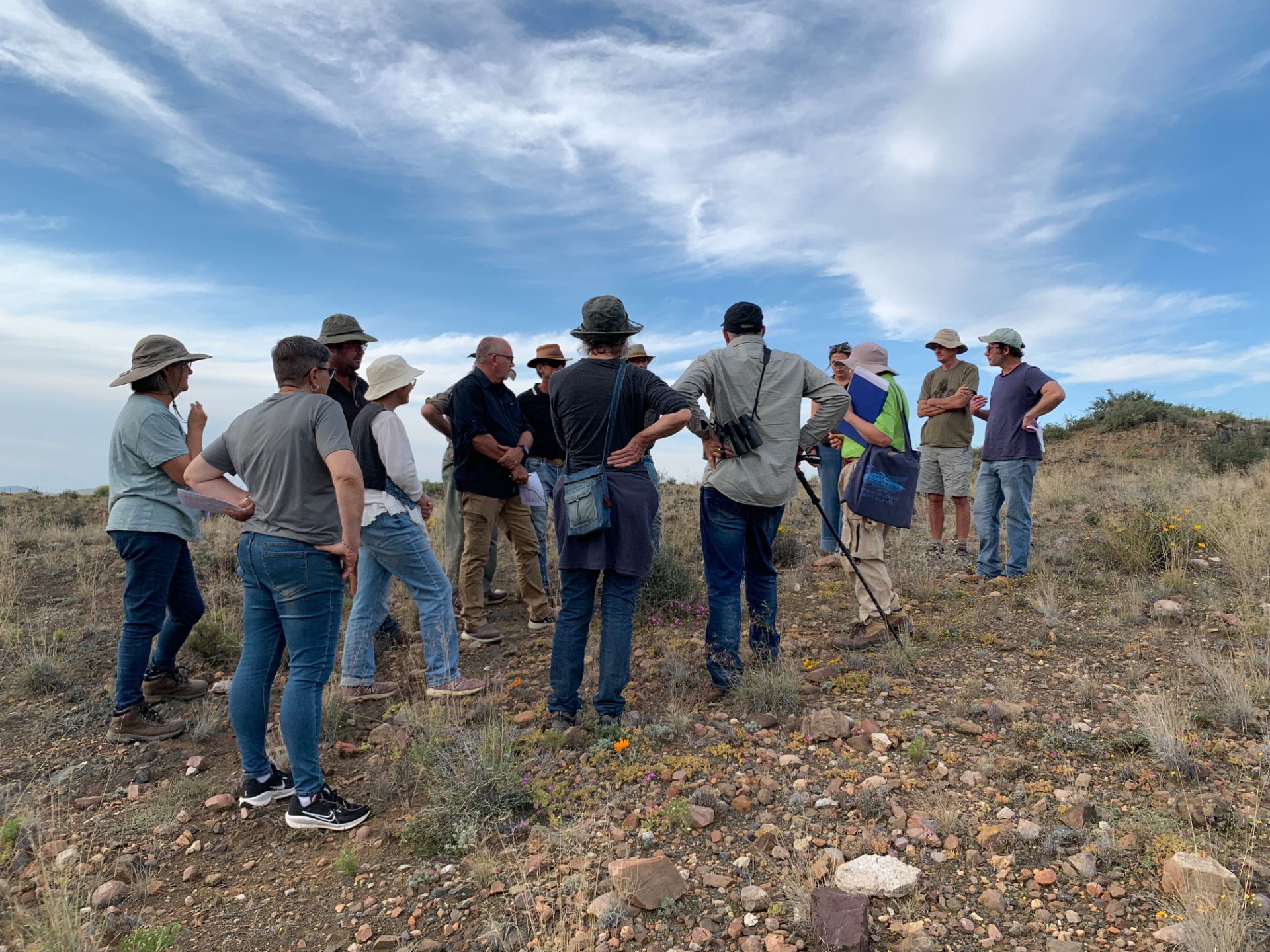
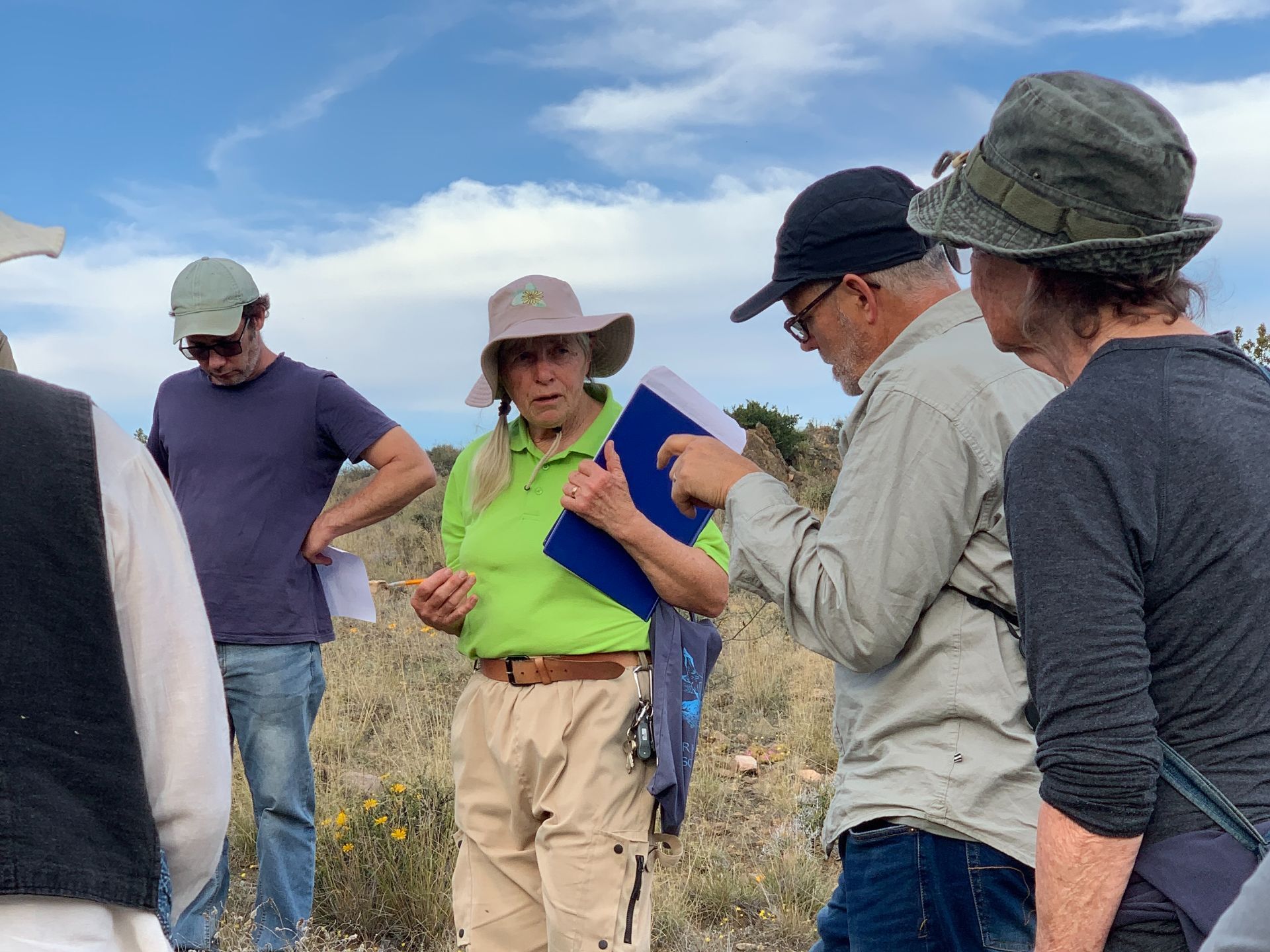
For forthcoming events and talks, see the Upcoming Events section of the newsletter.
Research and Education Centre Library and Archive
The library is usually open from 07.30 to 17.00 weekdays when Hinata Abe the WCRO intern is working in the Research Centre. Books can be read in situ but not removed from the premises. Books donated by Dr Judy Maguire, Sue Dean and estates of Richard Dean and Patrick Morant are being catalogued by volunteer Ailsa Tudhope.
A mini-herbarium of Karoo plants (about 1000 specimens) is being scanned by volunteer Maureen Cumming. These scanned images, labelled by genus number and species name, are stored on the laptop and hard drive. They will be supplemented with an ongoing collection of identified Karoo plant and animal photographs (ca 10,000) as reference material.
Geology and vegetation maps donated by Judy Maguire are housed in the map cabinet. Topographic maps at a scale of 1:50,000 and covering all Karoo quarter degree squares were donated by Sue Dean and are housed in boxes on the top shelf of the library. Stone and other Khoi and Khoekhoen artefacts have been catalogued, labelled and are housed in a steel cabinet.
The development of information posters has begun. These will be displayed in A0 and A1 clip frames on the walls of the library and lecture hall.
Interns
2026 Hinata Abe, a 3nd year work experience Nature Conservation student at NMU (George Campus) has made excellent progress with her study of the Tongblaar Vygie (Glottiphyllum neilii). Sue obtained funding from SAEON for Hinata to attend the Arid Zone Forum conference in Kammieskroon in October to present her findings as a poster presentation. Hinata has also helped to manage the research centre including events, visitors, refreshments and equipment.
Schools and Universities
Alice Parkington, a digital archiving specialist visited Prince Albert in March and August to develop a virtual field trip about the Dorps River as a source of water for the village and habitat for plants and animals. She is collaborating with Grant from Stanford University (USA). The virtual fieldtrip is designed for use by Grade 11 learners as part of the “Human Impacts” section of their syllabus.
Prof John Parkington (UCT), Prof Grant Parker (Stanford, USA) and four archaeology students visited Wolwekraal Nature Reserve from 10-12 August for practical training in archaeology. They also made use of the WCRT Research Centre for lectures and workshopping.
Second year Nature Conservation students from NMU (Saasveld) visited Wolwekraal Nature Reserve with Dr Joh Louw and Willem Matthee on 25th August.
Local Community Organisations
WCRO is collaborating with Slimlappies (an Afrikaans sport and educations NPO) to take 20 local school-goers into nature once monthly for 36 months. Here they learn about the flora and fauna, experience nature with all the senses, and capture it on paper! Funding to purchase snacks and drinks for the learners has been granted by WWF through CapeNature. The first two walks, one on Wolwekraal Nature Reserve and one on Gordon Koppie were very successful and well attended. In addition to Thana de Clerk and Annemie Boshoff of Slimlappies, Anika van Aswegen, Anna Stone, Denise Kime and Ilse Schutten volunteered to assist Sue Dean with these excursions.
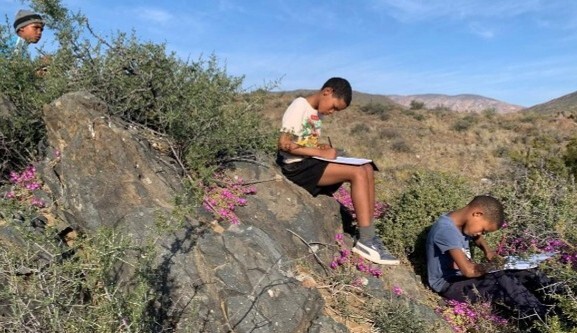
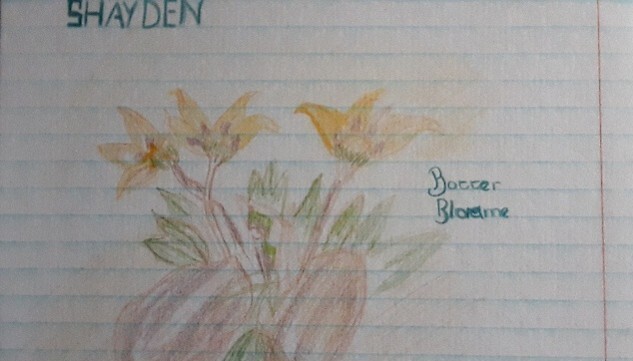
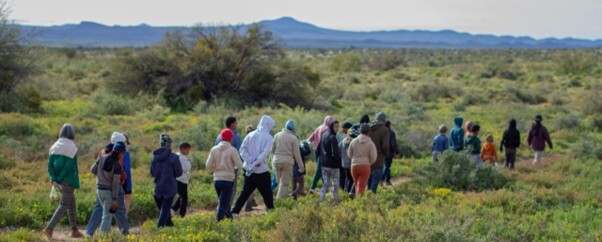
Nature Walks with Slimlappies students
Nature Connect, a NPO that focusses on training in Nature Based work, will be running short courses on chainsaw operation, trail maintenance and first aid in Prince albert from 19-23 October 2026. WCRO and Renu-Karoo will facilitate this by offering a venue for the chainsaw training at Renu-Karoo and in the invasive Tamarix population along the Dorps River. WCRO will also assist with the trail maintenance training that will take place on the Gordon Koppie.
Newspaper Articles
From March to May, the Nature and Gardens section of Prince Albert Friend published an article by Hinata on garden birds.
Television
Wolwekraal Nature Reserve and Renu-Karoo were featured in a short documentary in the Fiesta series of Kyknet on 1 August 2026.
Research
Archaeology
Prof John Parkington, Prof Grant Parker of Stanford University, Alice Parkington and three Stanford University students visited Wolwekraal Nature Reserve from 10-12 August to document the origins of the materials used to make the stone artefacts present on campsites of indigenous people on that property.
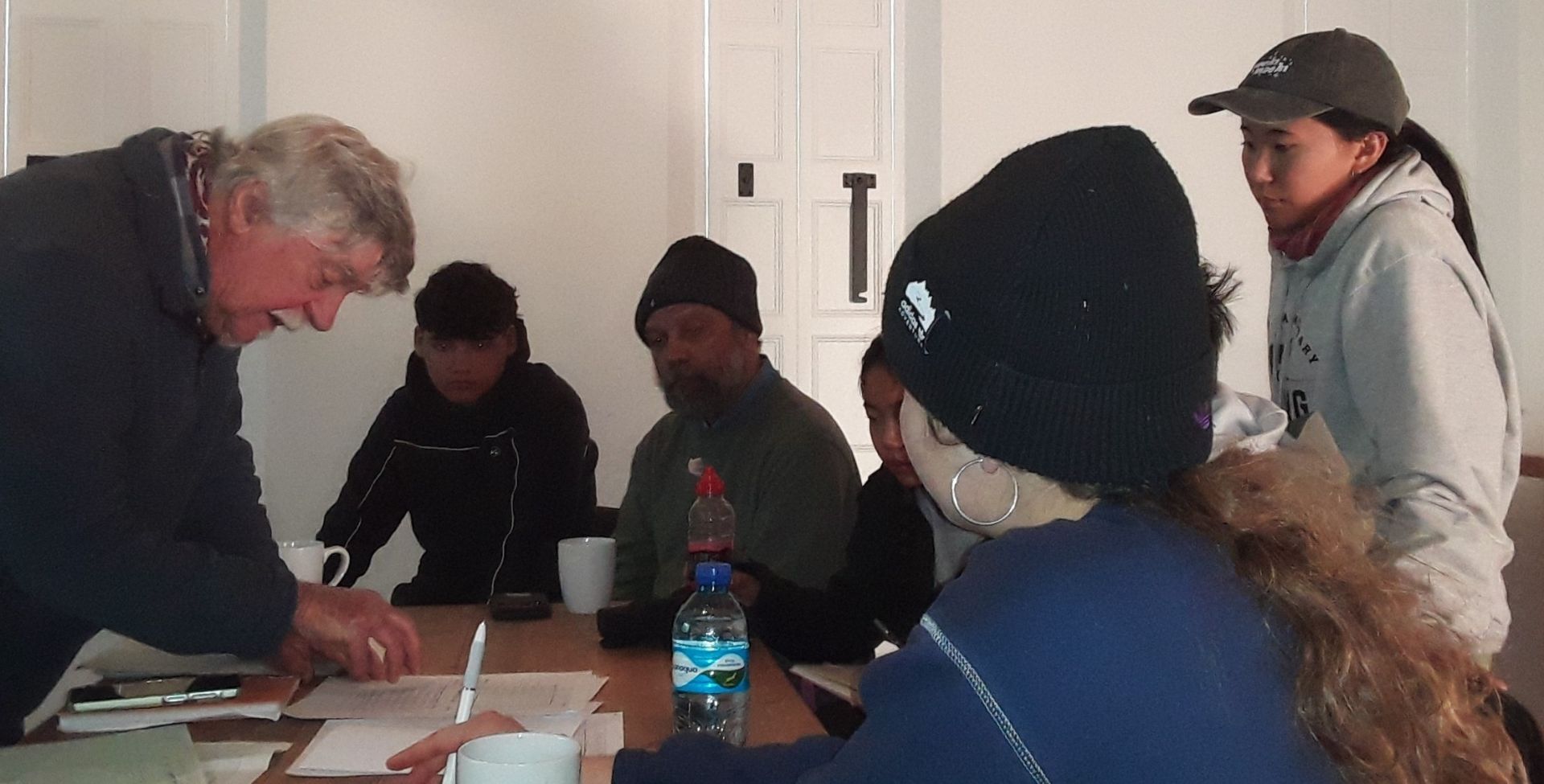
Prof. John Parkington running an archaeology workshop with Prof. Grant Parker and students from Stanford University in the Research Centre
Climate Data
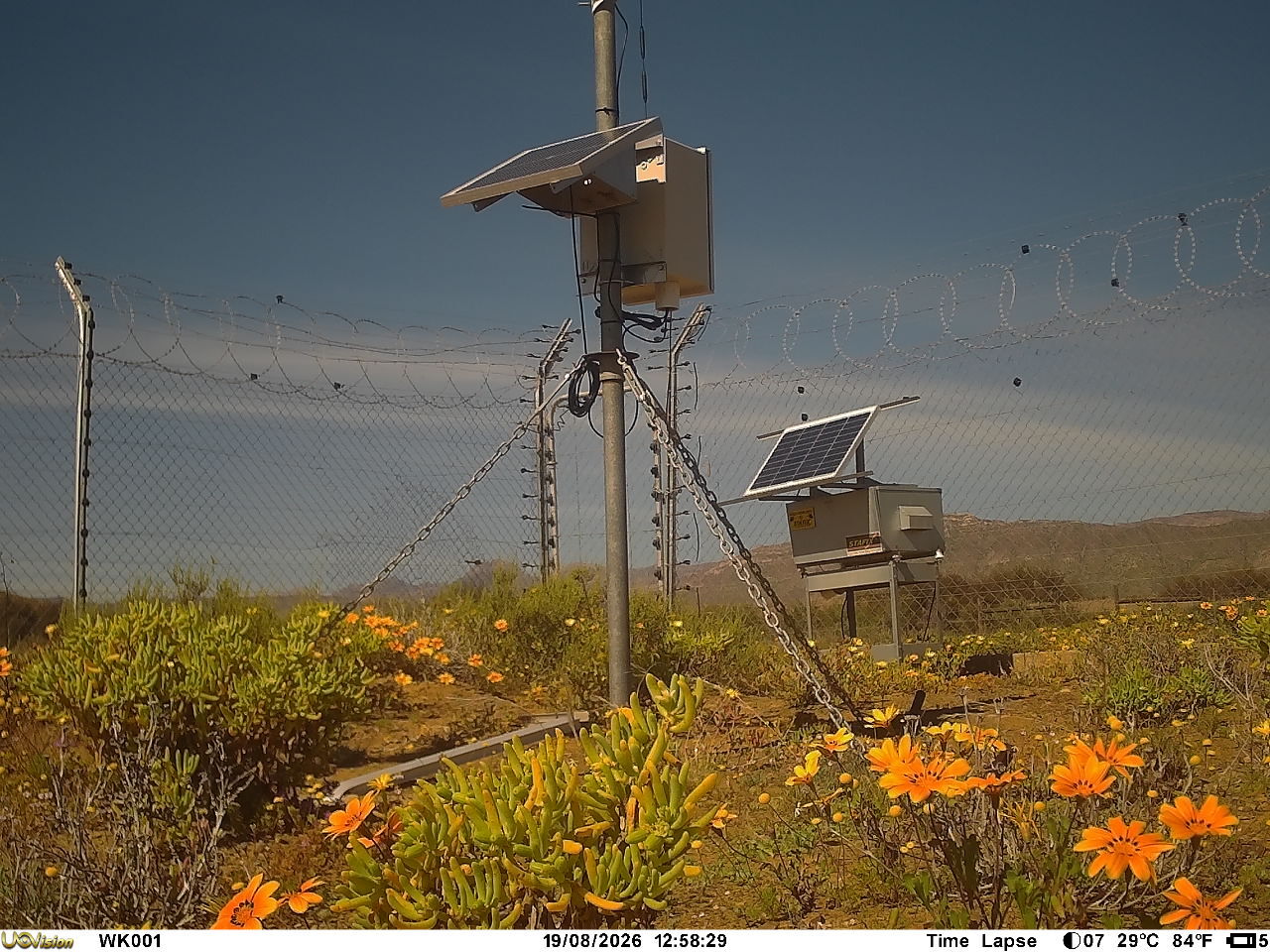
SAEON installed a new weather station on Wolwekraal Nature Reserve on 15 July 2026 to replace the old station which had stopped working.
Entomology
Karin Sternberg spent 20 days in Wolwekraal Nature Reserve and surrounding areas in July to continue her studies on wild honeybees and solitary bees.
Dr Karla Jaschke, a German PhD student with Prof Iain Paterson of the Centre for Biological Control at Rhodes University visited Wolwekraal Nature Reserve to collect potential biocontrol insects on Stinknet / Stinkkruid (Onchosiphon pilulifera) and related plant species in July and again 11-12 August.
Dr Cassandra Barker, a postdoctoral fellow at the KwaZulu-Natal Museum in Pietermaritzburg will return to collect Bombyllid flies WNR. She recorded 12 Bombyllid species during her March field trip, improving knowledge of the distribution of these important pollinators.
Plant Population Ecology
Hinata Abe has mapped the distribution of the endemic vygie, Glottiphyllum neilii on Wolwekraal Nature Reserve, and on 7 adjacent properties. She has recorded the population structure on 18 sites, investigated pollination, recorded herbivores and fungal damage. She successfully motivated for genetic analysis of G. neilii and G. nelii by the 1KSA genome sequencing project of the Department of Science, Technology and Innovation. She is currently writing up her report for NMU. The research will determine whether the status of the local endemic G. neilii should be changed from Least Concern to Near Threatened or Endangered.
Dr Gina Arena visited Prince Albert in June and carried out a survey of the Lithops localis population on the PA Airstrip with the assistance of Hinata Abe and Sue Dean. Sue Dean surveyed Lithops in two populations on Wolwekraal Nature Reserve in July to document the damage caused to the populations by rotting.
iNaturalist Projects
We have established iNaturalist projects for Wolwekraal Nature Reserve, and for Gordon Koppie. There are currently 579 plant and animal species (1,807 records) for WNR, and 362 plant and animal species (1,536 records) for Gordon Koppie. Our team is dedicated to uploading their observations to the platform to improve records of fauna and flora in the Prince Albert area.
To view the projects, visit:
Flora and Fauna of Wolwekraal Nature Reserve
Publications
Online
van der Merwe H., Milton SJ. 2026. Fine-scale vegetation mapping reveals shrub survival and recruitment patterns over 27 years in arid Karoo rangeland. African Journal of Range & Forage Science https://www.tandfonline.com/eprint/3ZF7VWATAJMDTSN5CAGS/full?target=10.2989/10220119.2026.2660901 (SAEON, WCRO)
Neethling CD, Esterhuyse S, Milton SJ, Henschel JR. (subm 2026.07.30) Developing an ecological restoration assessment framework for summer rainfall terrestrial drylands. African Journal of range and Forage Science. (SAEON, WCRO)
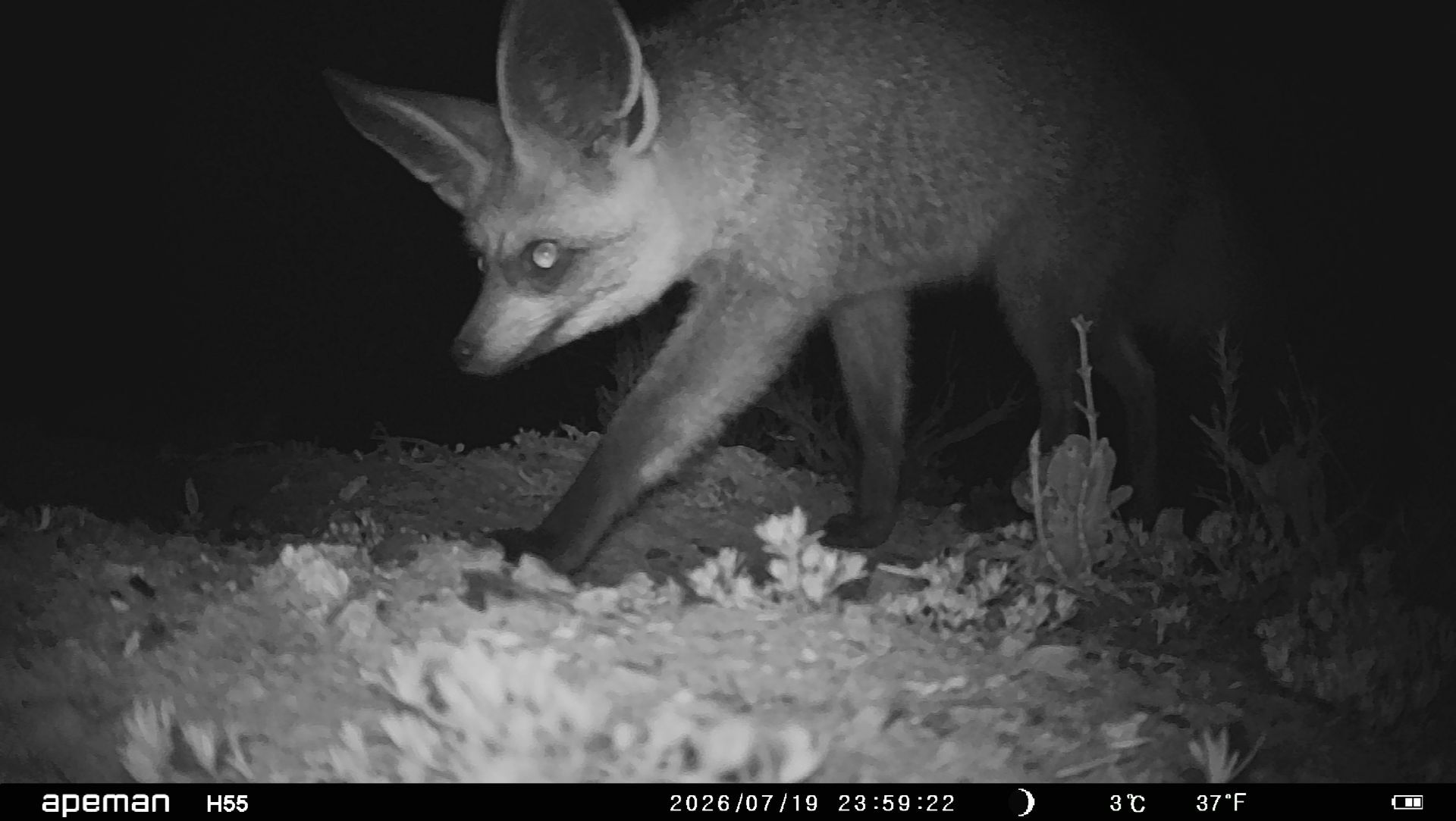
From Our Wildlife Cameras...
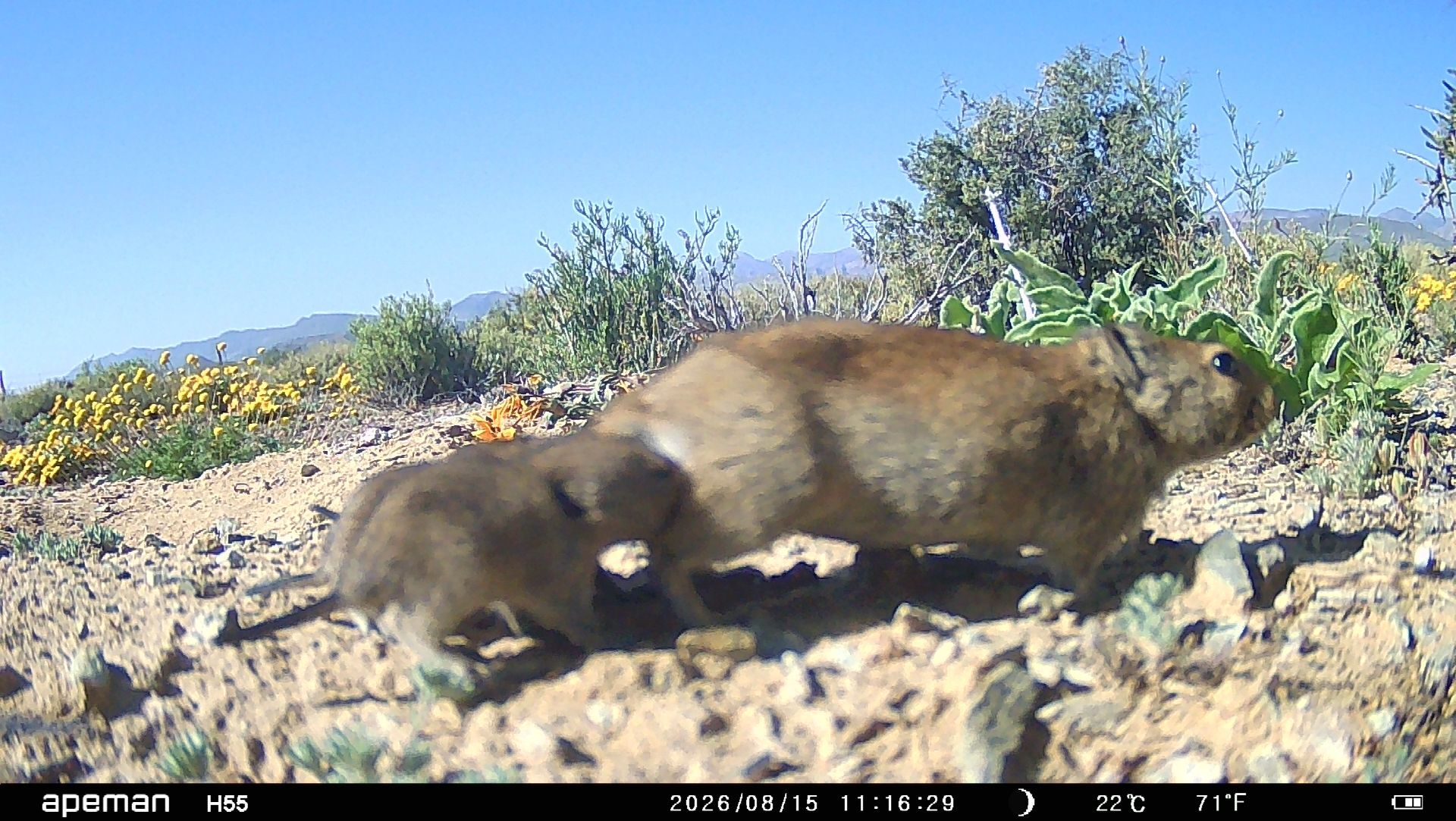
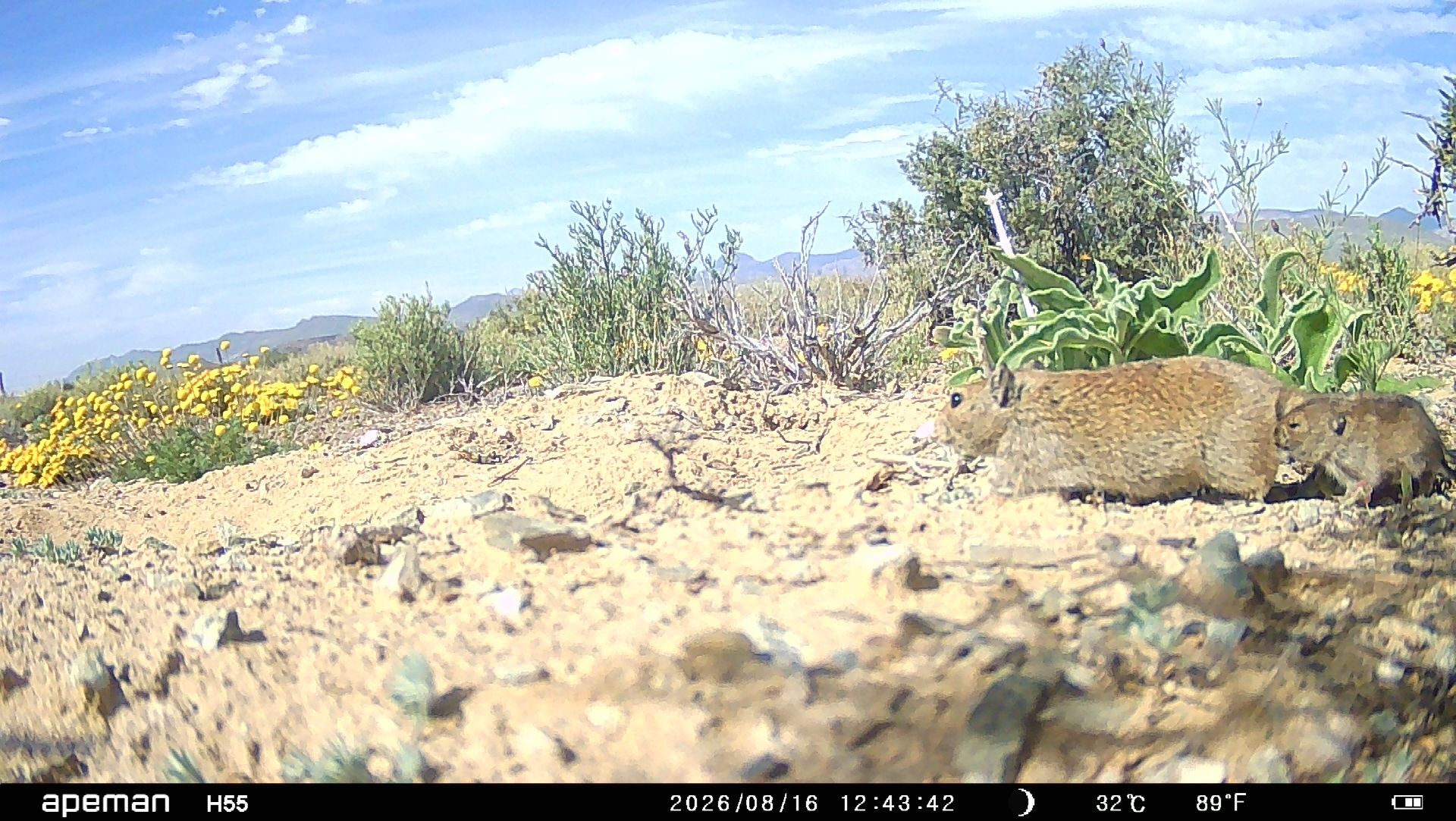
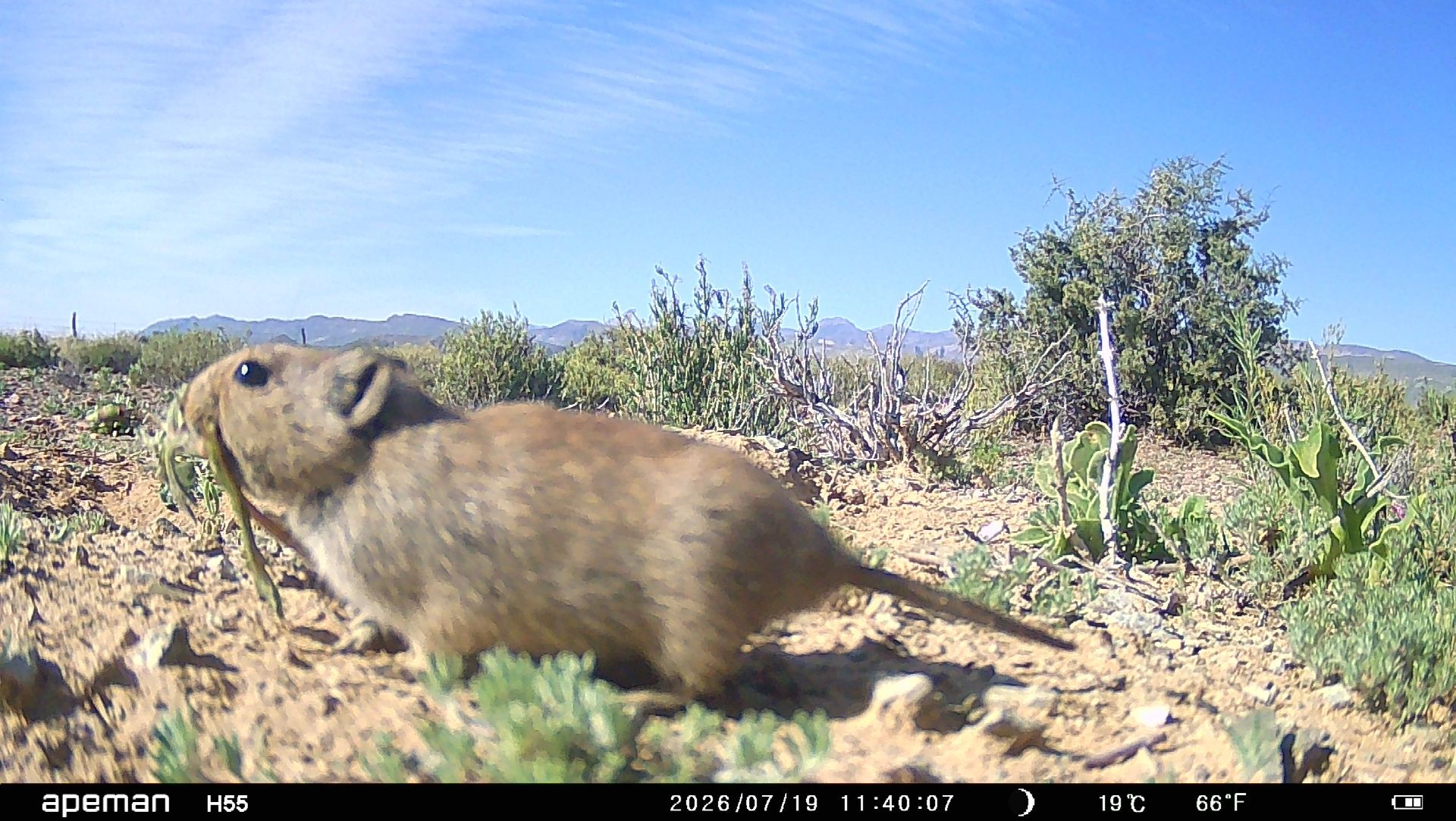
Whistling Rats
With young, and foraging:
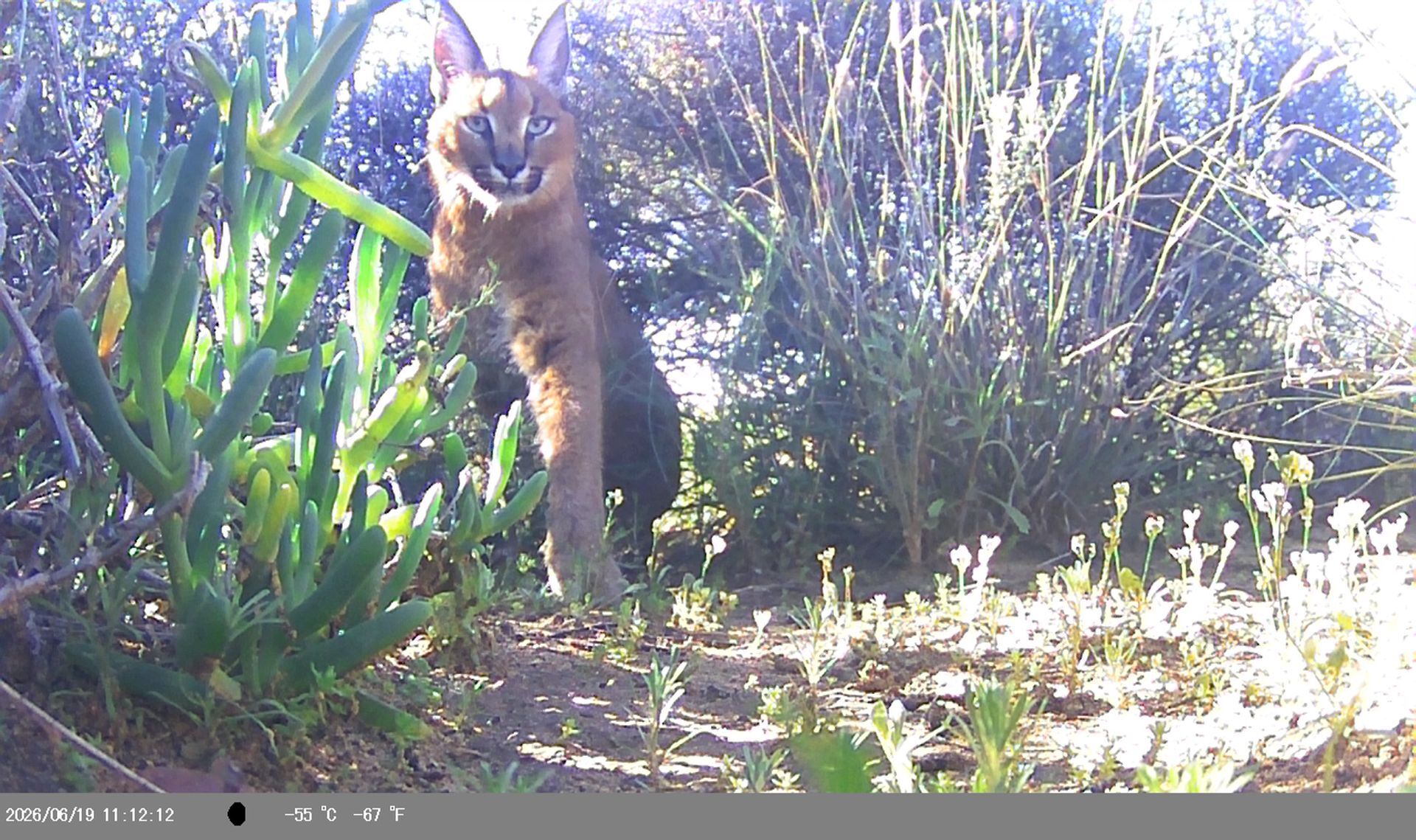
Caracal
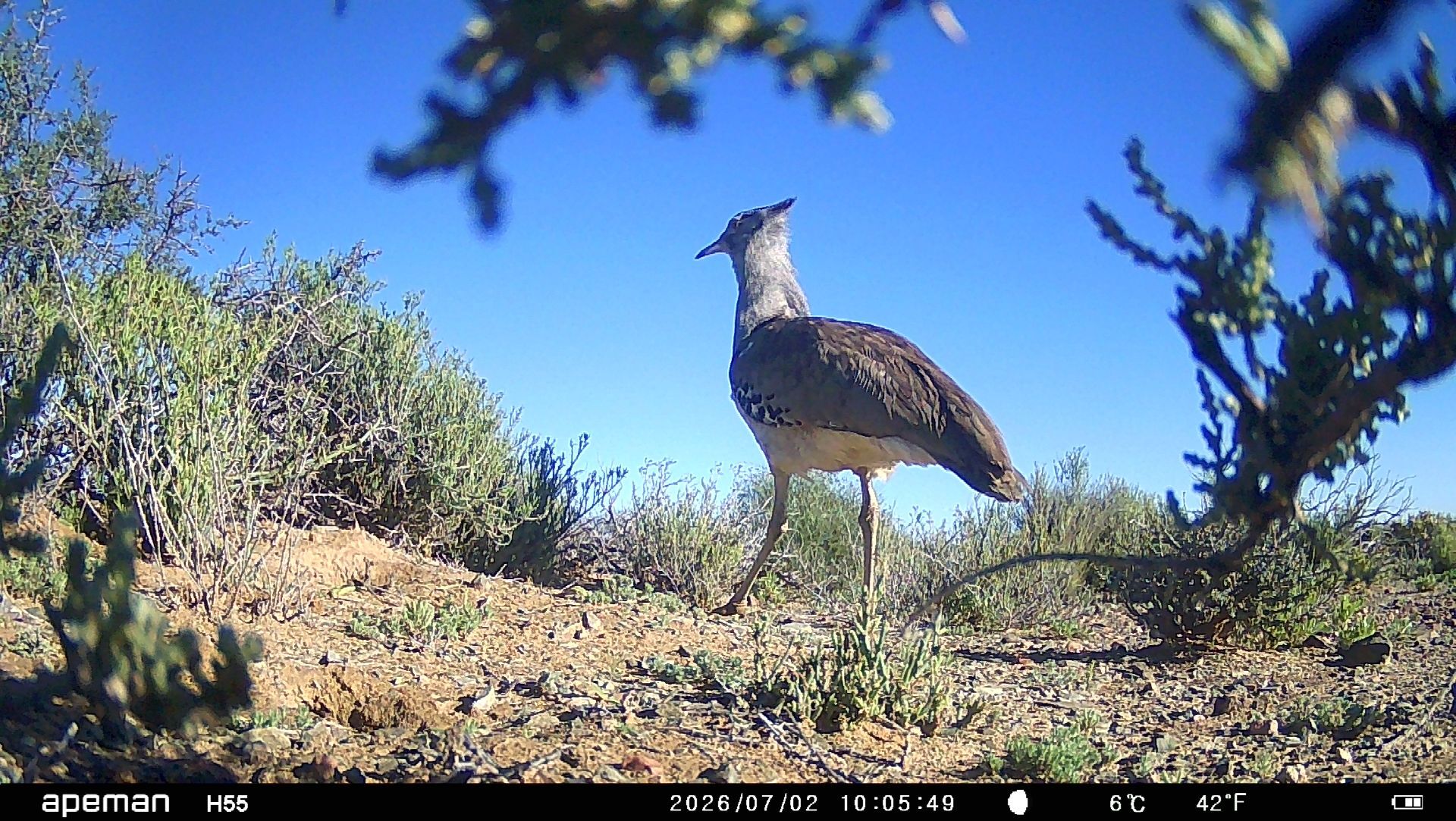
Kori Bustard
Bat-eared Fox
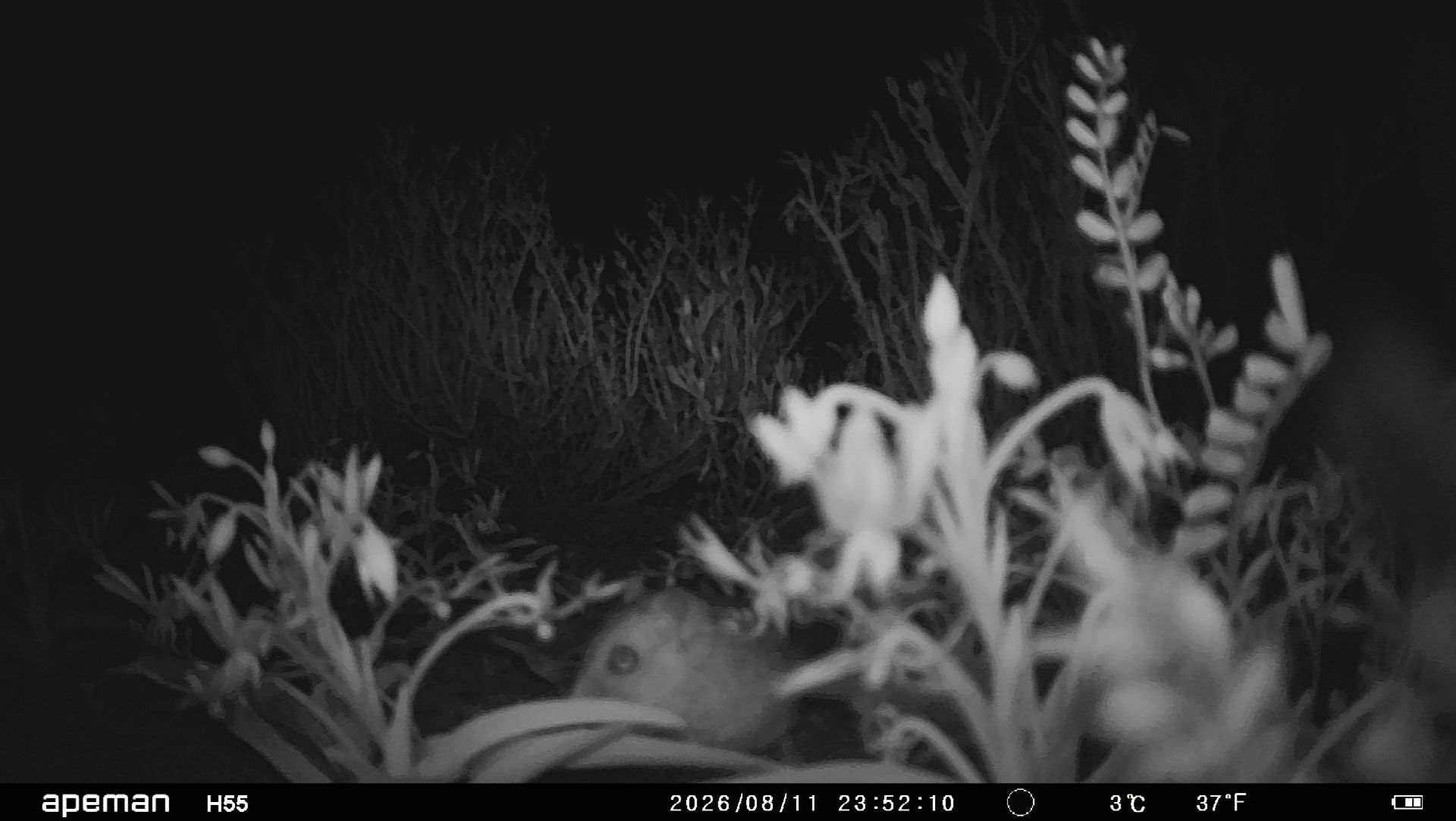
Elephant Shrew
Possible pollinator of Snake Lily (Ornithoglossum vulgare)
Plant Spotlight: Felicia macrorrhiza
Felicia macrorrhiza is commonly known as the 'Cinderella Felicia', or 'Aspoestertjie' in Afrikaans. The Afrikaans name is probably derived from its seed heads, which are light and brush-like, allowing for dispersal by wind. These plants have come alive on the reserve over the past few weeks. They only flower after really good rain, and we last saw them flowering so prolifically in 2023. Felicia macrorrhiza is highly palatable to livestock. It is productive too, and therefore valuable to farmers in the Karoo. Being a small and accessible plant, it is likely to disappear from overgrazed veld. There is a good, stable population of this species on Wolwekraal Nature Reserve.
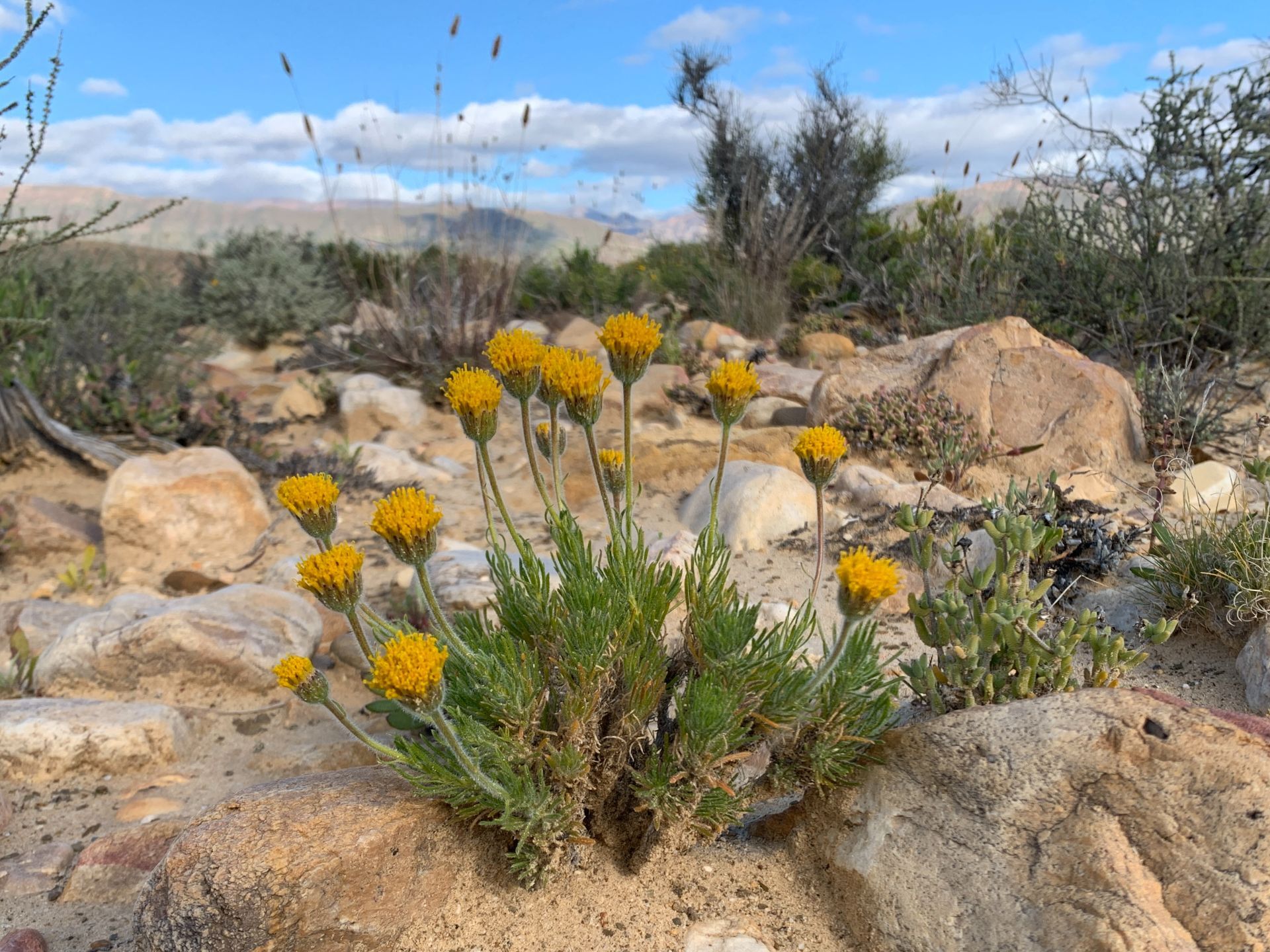
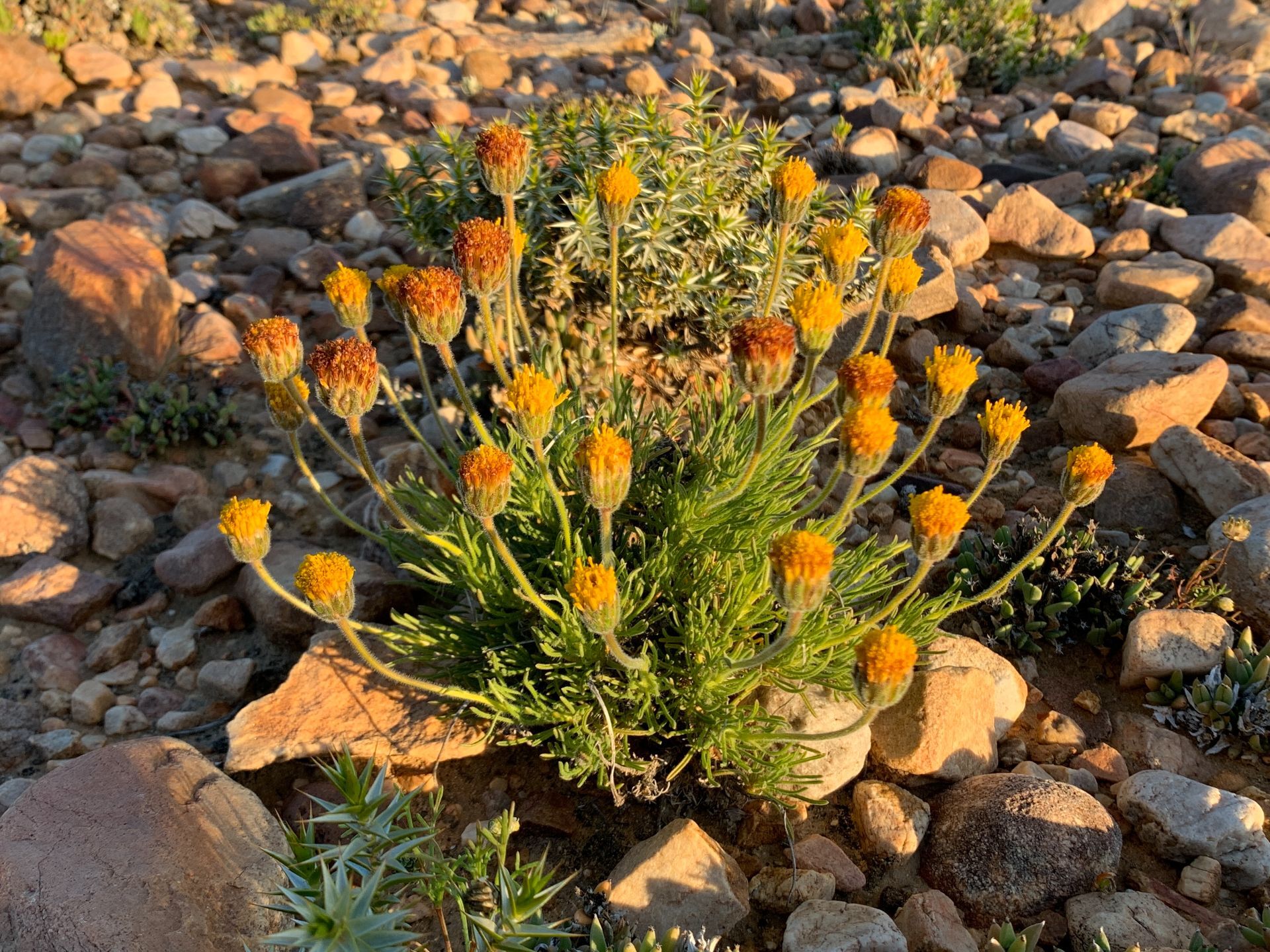
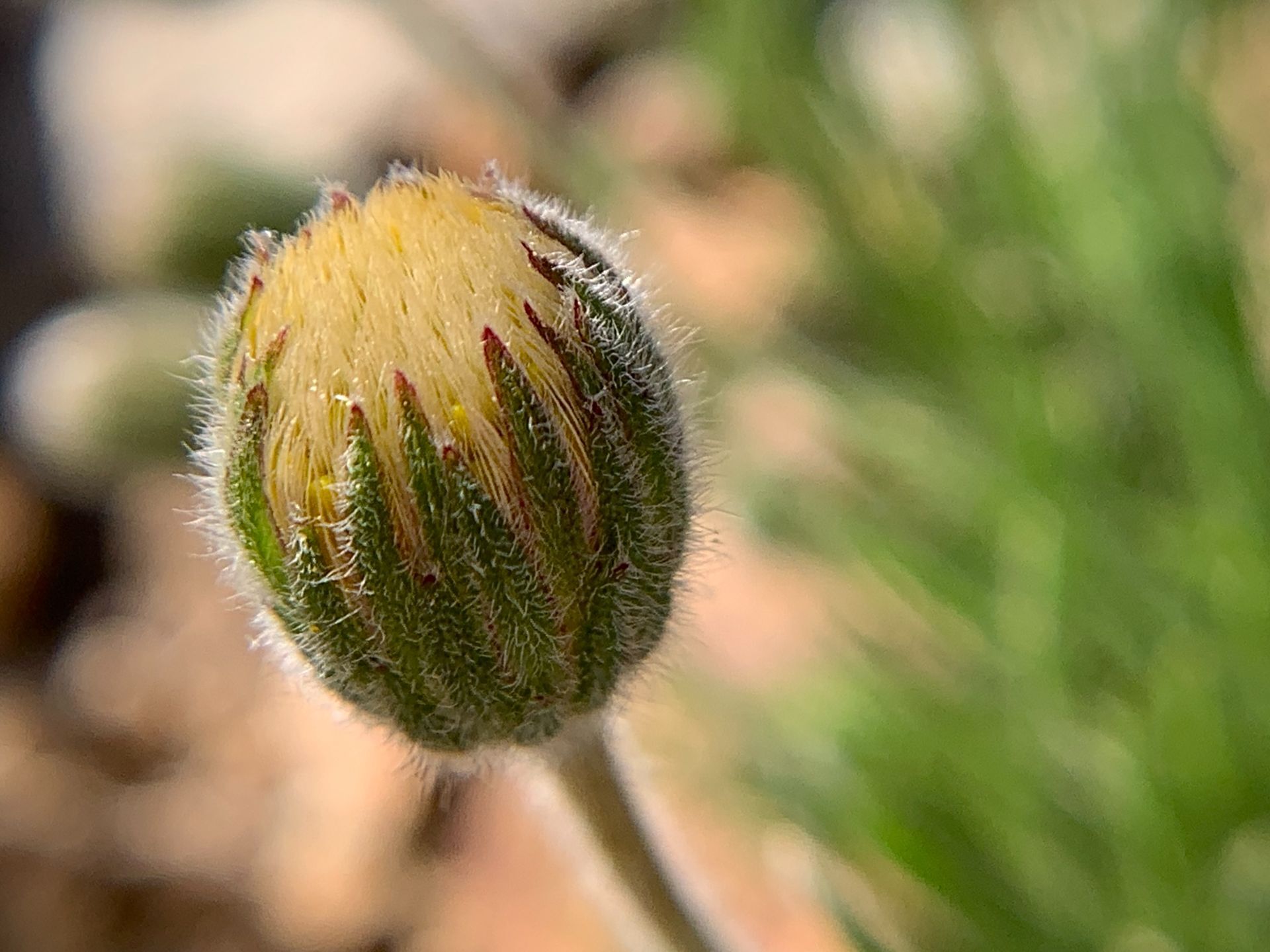
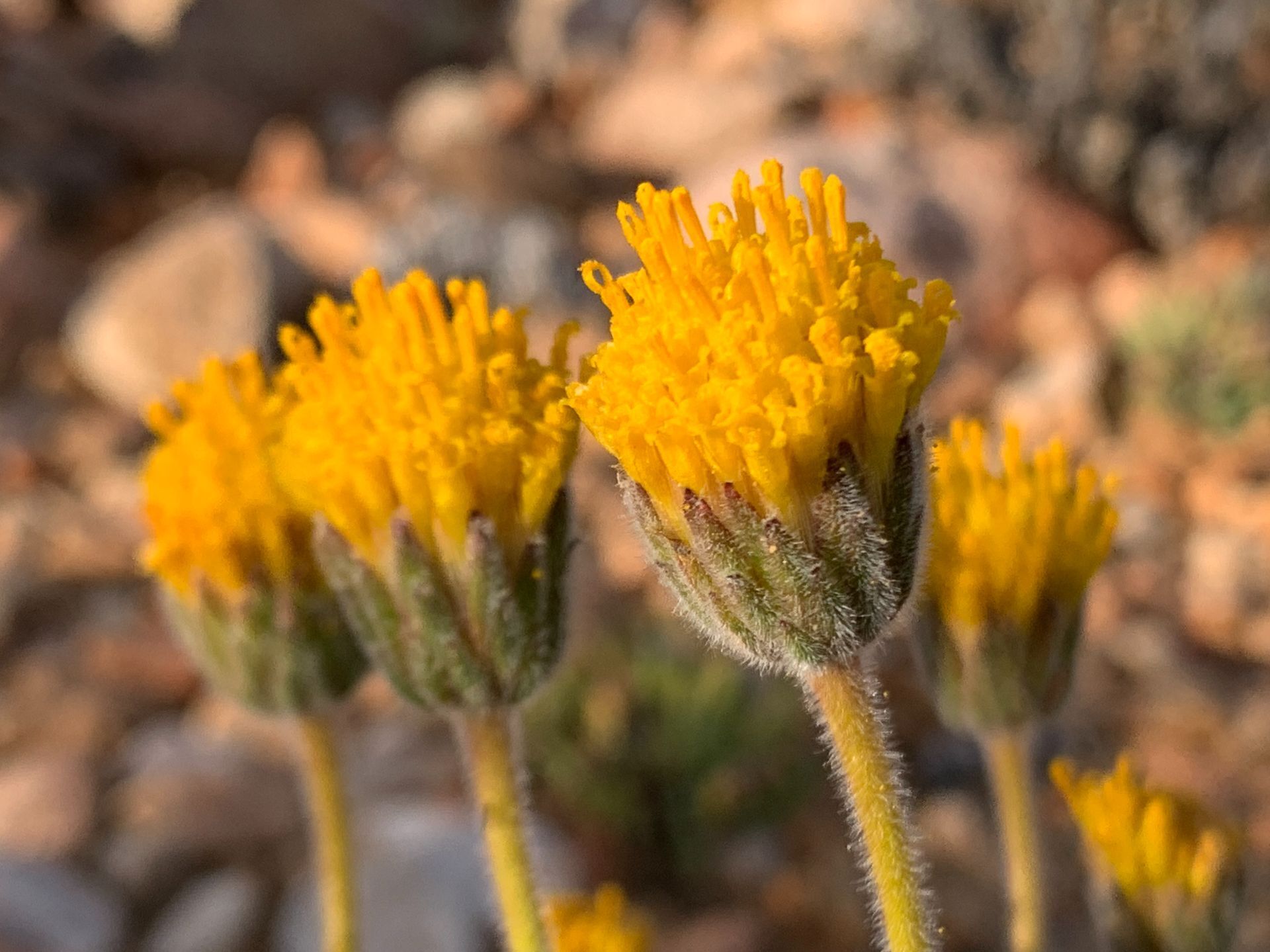
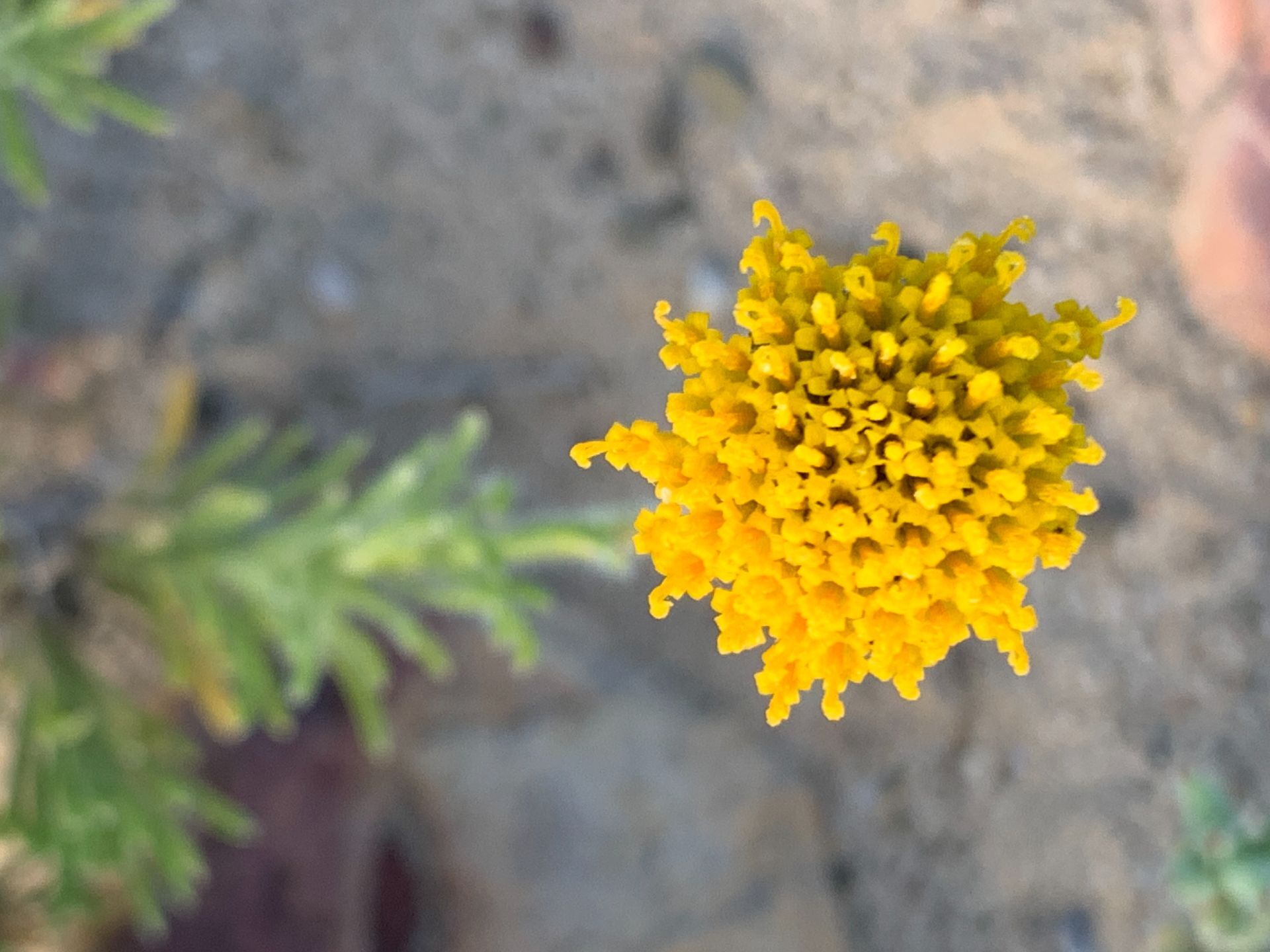
Felicia macrorrhiza, photos by Collette Hurt
The Golden Spring of August 2026: Too Much of a Good Thing?
By Sue Milton-Dean
At 11am the Botterblomme petals open. Millions of them. They turn the landscape a dazzling gold. The spring seems more spectacular than those over the past decade. Why is this? From 2015 to 2022 the Karoo was scorched by drought and heat. The veld was grey, the bushes leafless, water restricted. We despaired. Would we ever again see rain? In March 2023 at last the clouds built up, thunder booms, rain falls and by August brilliant purple vygies transformed they grey veld. They must have over-exerted themselves because they did not flower in 2024. Instead, there was a sprinkling of golden Gazanias that spring. The Autumn and Winter of 2025 were dry. There were no flowers to celebrate the spring. The summer continued hot and dry all the way through to March 2026. Then in April the rain started and continued through May and June. We had more than a year’s rain in three months. Skies were overcast for weeks, humidity remained over 75% for three months and the soil stayed wet. Seeds left by the 2024 botterblomme germinated in their millions and grew fast and strong. By July botterblomme covered most of the ground. An extraordinary sight. May 2026 is the only month in the 120 year record with 135mm rain – the next highest being August 1882! Rain exceeding 300 mm has been recorded in Prince Albert in only seven years (1911, 1921, 1976, 1985, 1996, 1998, and 2026). Although the spring flowers have thrived in the humid conditions, many of our specialised drought-tolerant succulents rotted and died. Among these were Asbos, Steekvy, Tongue-leaved Vygie, Prince Albert Vygie, and Beeskloutjie.
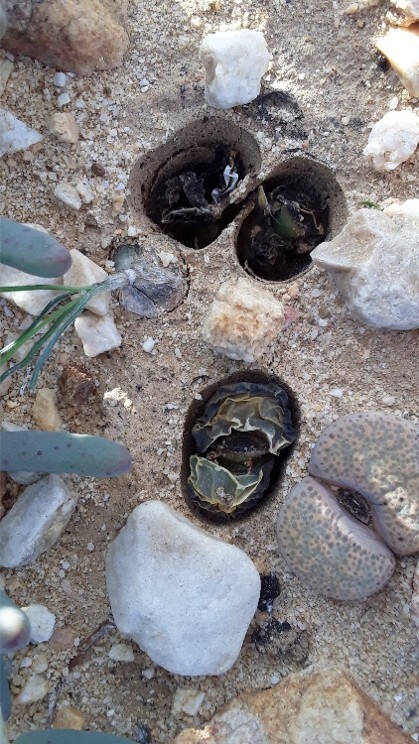
Rotted Lithops plants
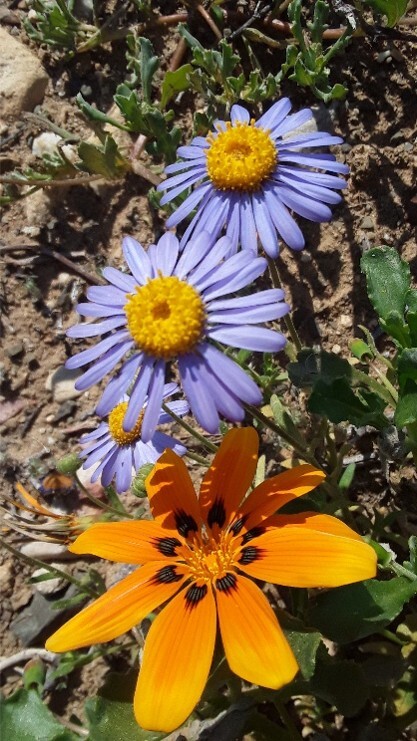
Abundant annuals
Velvet Ants on Wolwekraal Nature Reserve
By Karin Sternberg
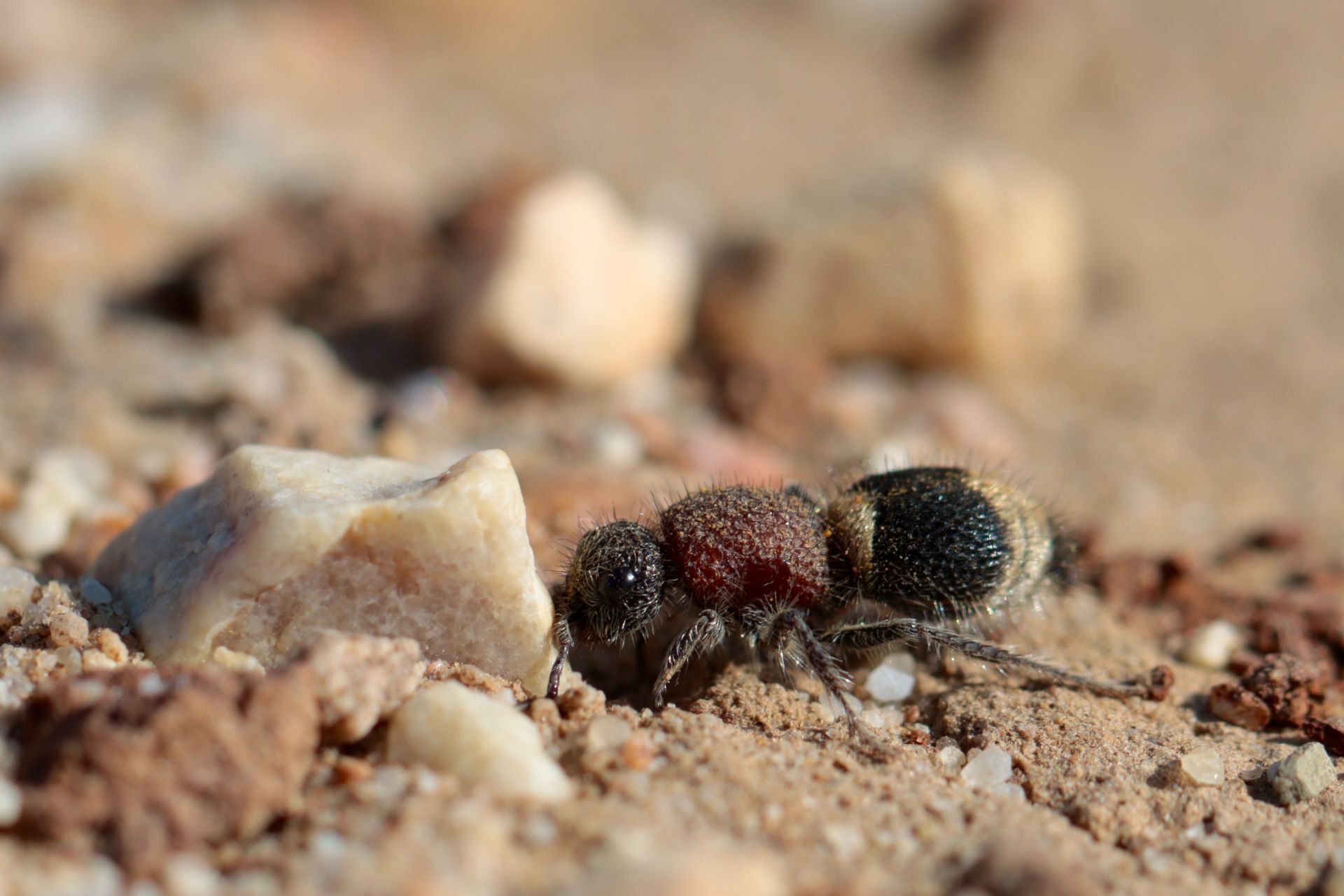
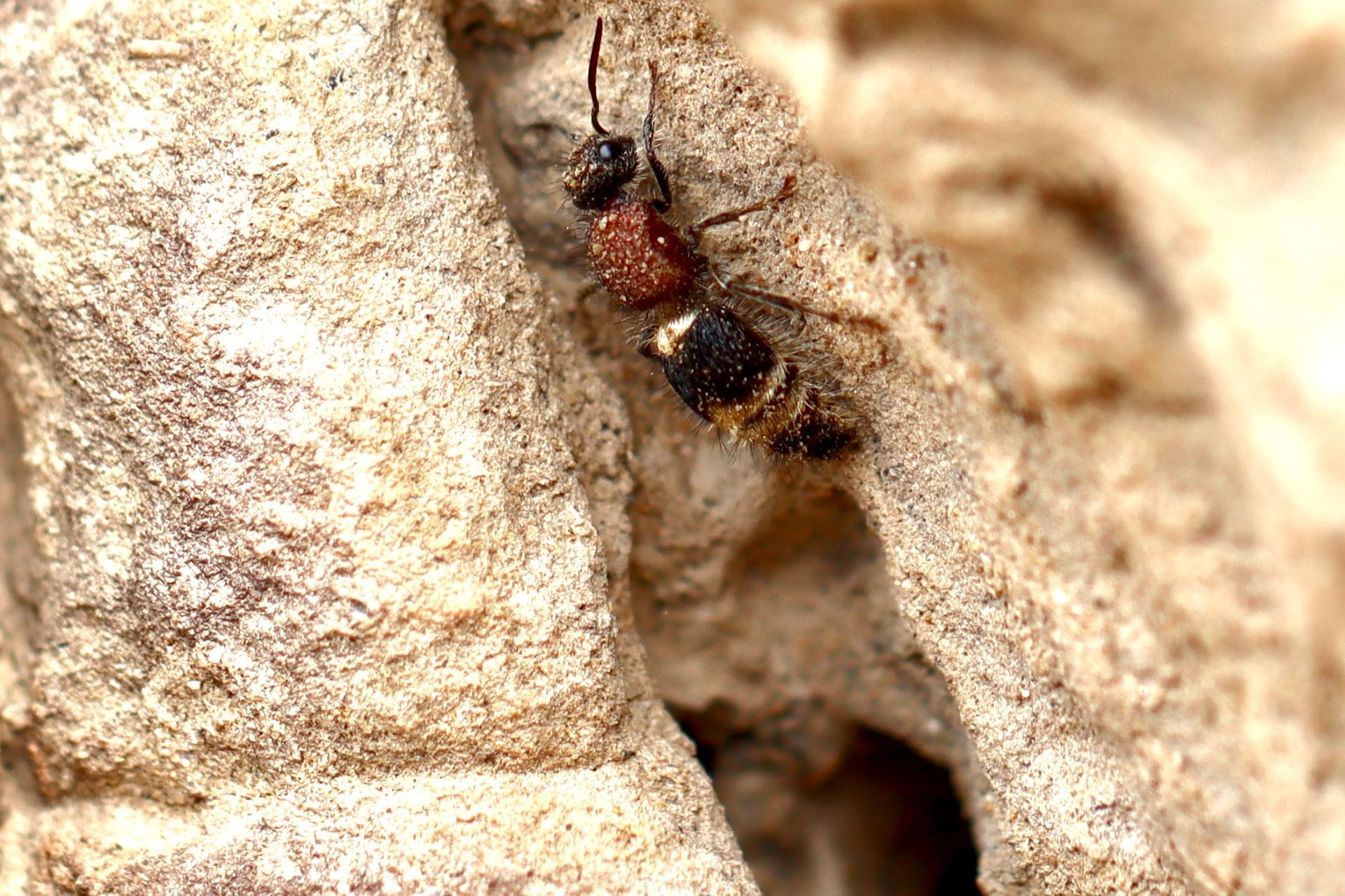
Midday on Wolwekraal Nature Reserve is one of the best times to go looking for Velvet Ants (Mutillidae family). The female can often be seen racing over the ground or up and down the riverbank, searching for the nests of solitary bees. Despite their name, velvet ants are wasps. The females are wingless, spending their lives on the ground. They have striking colours, with different species displaying their own distinctive patterns. Their tough body armour and warning colours help protect them from predators. These, together with their quick movement and formidable sting, make them difficult for predators to catch.
Once a female finds a suitable bee nest, she enters it and lays an egg. Her offspring will then feed on the protein-rich bee larva as food. Interestingly, while their young are ruthless carnivores, the adults live entirely on nectar as their source of energy. The males are completely different. They have wings, and in some species, they carry the wingless females during mating flights. South Africa has a wonderful diversity of these extraordinary wasps, known in Afrikaans as fluweelmiere.
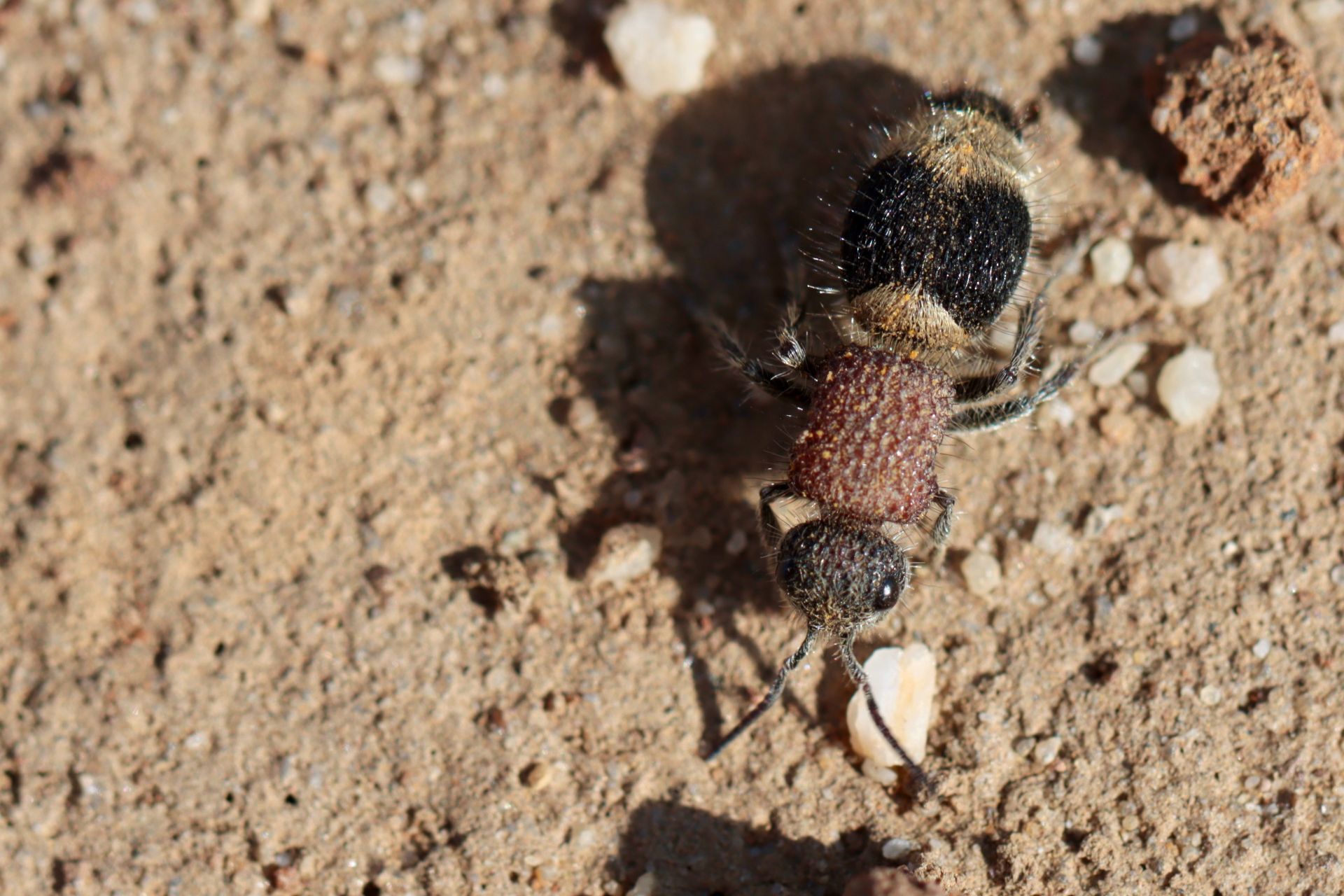
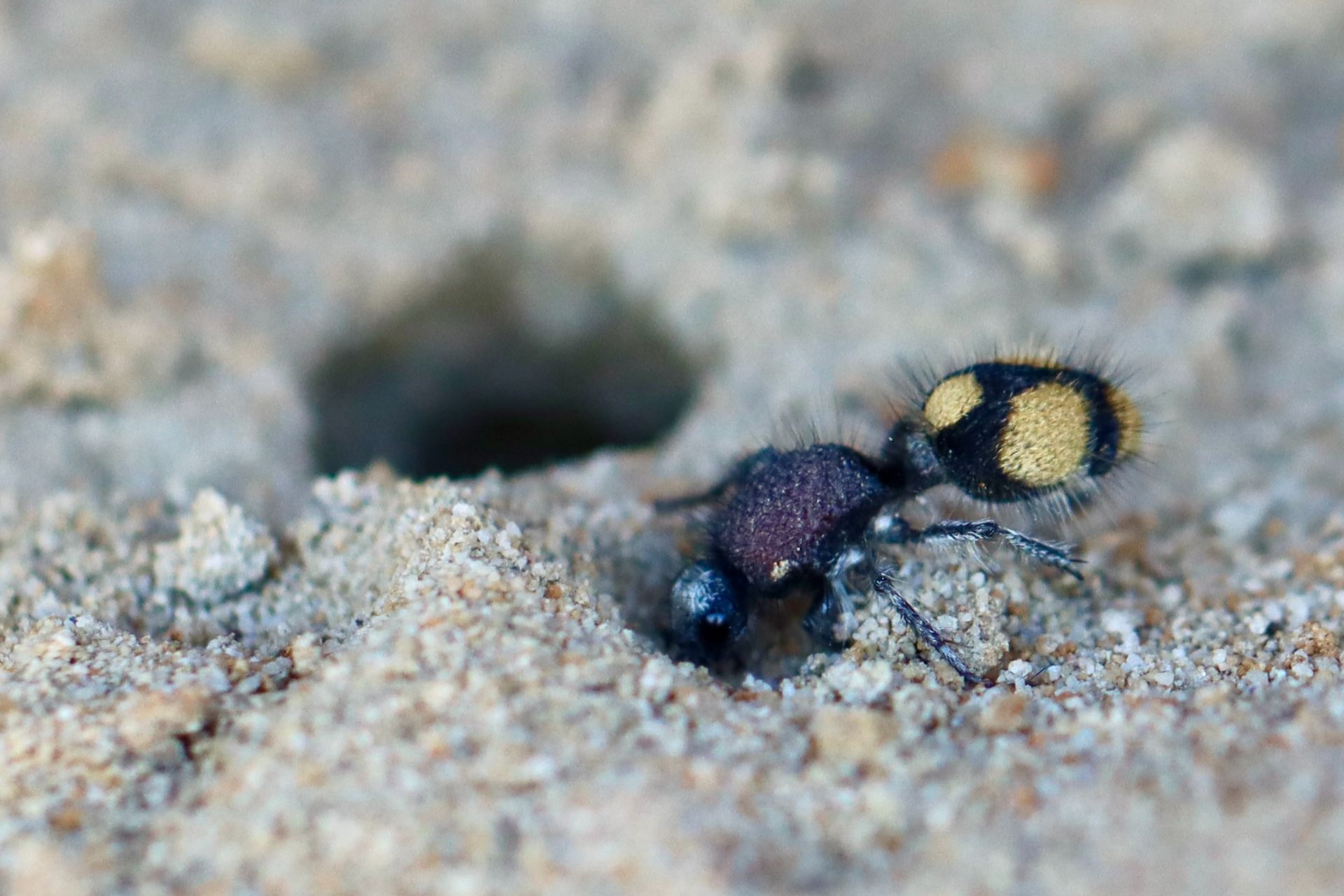
Velvet Ants, photos by Karin Sternberg
Update on the Study of the Tongue-leaved Vygie (Glottiphyllum neilii)
By Hinata Abe, 2026 Wolwekraal Intern
The research team has been collecting data primarily on the distribution, habitat, and population composition of the rare endemic succulent Glottiphyllum neilii. I would like to share the following updates of the study with you:
Glottiphyllum neilii has an extremely limited distribution with populations scattered across its range. We have discovered that this species occupies only approximately 50 Ha in total across 8 sites in the Prince Albert area. This finding will classify G. neilii as Endangered (EN) under the IUCN Red List criteria and may significantly contribute to the future conservation of the species.
The age-class structure is highly dominated by individuals in the juvenile phase, with mortality increasing as the plants mature. The most common causes of mortality are animal predation, trampling, and disease infection, while mortality due to old age and heat stress/ desiccation appears to be relatively rare.
Various populations of soft succulents, including Malephoropsis, Lithops, Drosanthemum, and Mesembryanthemum, were severely affected by root rot and fungal attack resulting from the high rainfall during May and June 2026. Although some of the G. neilii population was severely affected by moisture-induced fungal attack and died out completely, some surviving individuals have demonstrated their ability to recover after a prolonged period of unusually wet conditions.
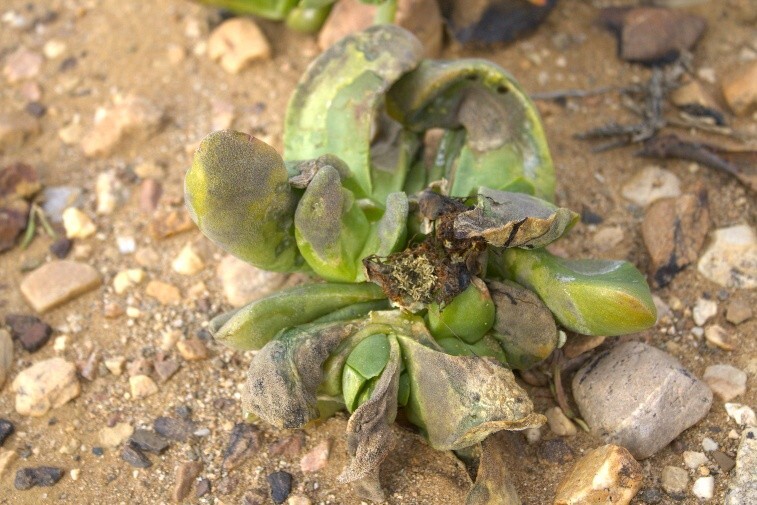
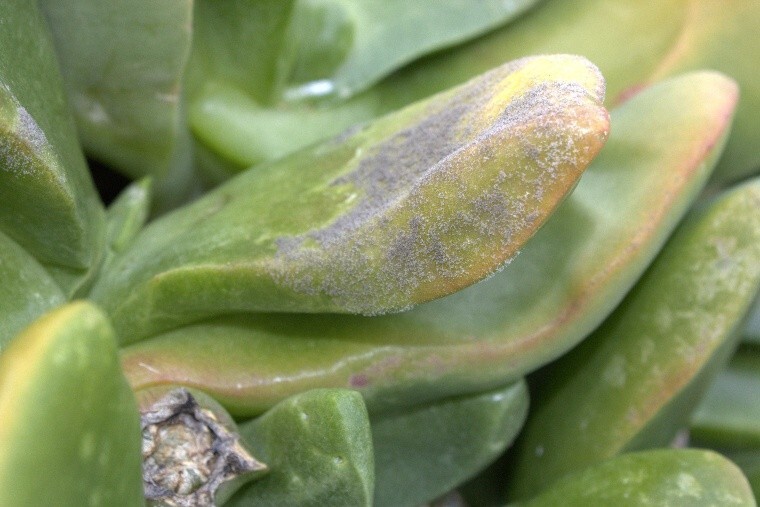
Fungus on the leaves of Tongue-leaved Vygie (Glottiphyllum neilii)
Bird Hide Project
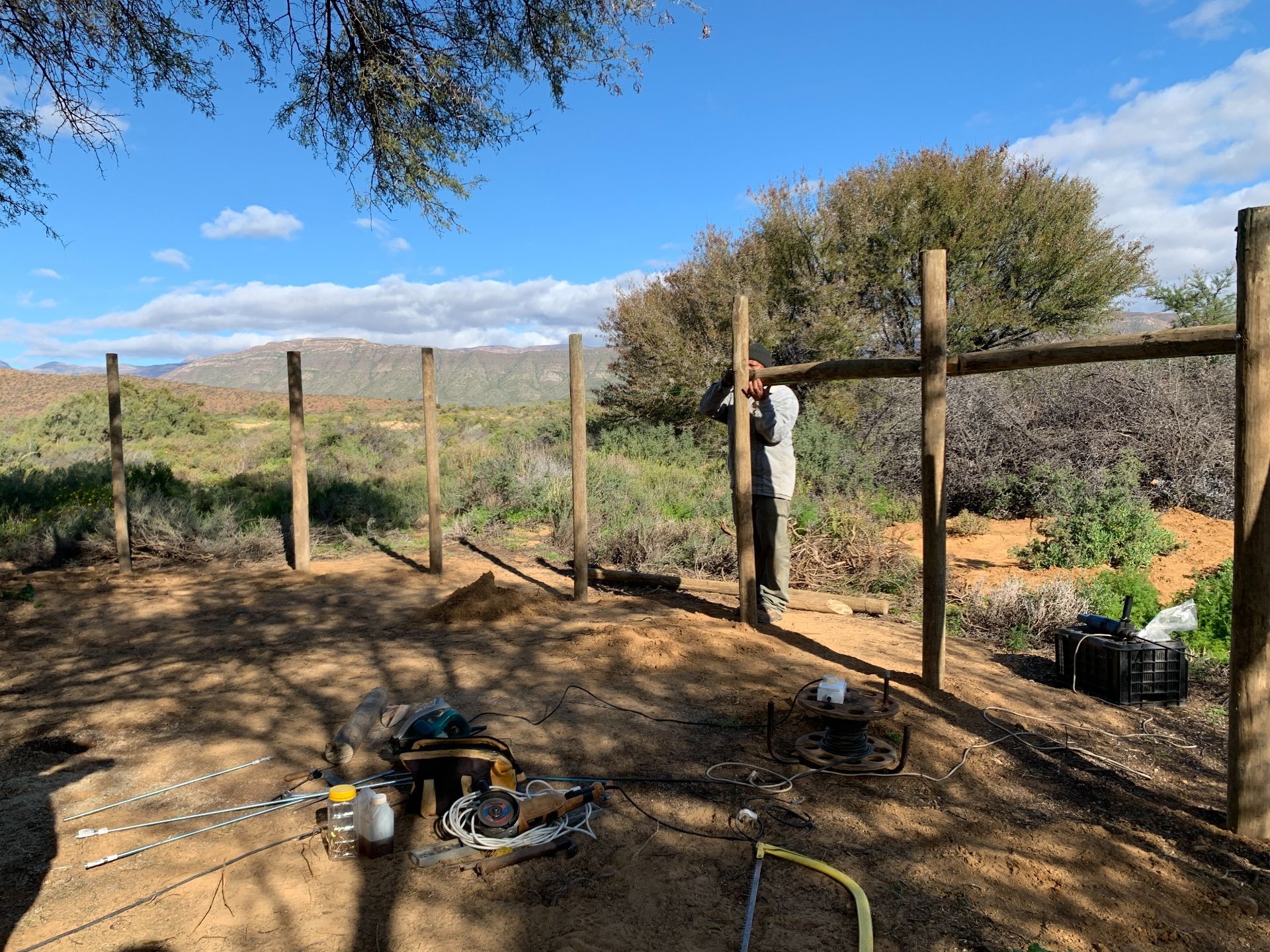
A new tourism initiative on Wolwekraal Nature Reserve is the making of a bird route and bird hide. The task team (comprising Patrick Kime, Bertus Fourie, Collette Hurt, and Hinata Abe) identified a suitable site for a bird hide under an isolated sweet thorn tree on plains between the reed bed and the river. Renu-Karoo has begun construction of the hide using a stick lapa technique. We look forward to completing the project in the next few months.
Renu-Karoo
Renu-Karoo Veld Restoration works alongside Wolwekraal Nature Reserve. The nursery supports conservation through its work - it propagates, promotes and conserves indigenous plants by making them available to Karoo gardeners, landscapers and restoration practitioners.
Below are some of the local species that they grow and promote for gardens in the area. Many of these can be viewed at the WRCT Research and Education Centre.
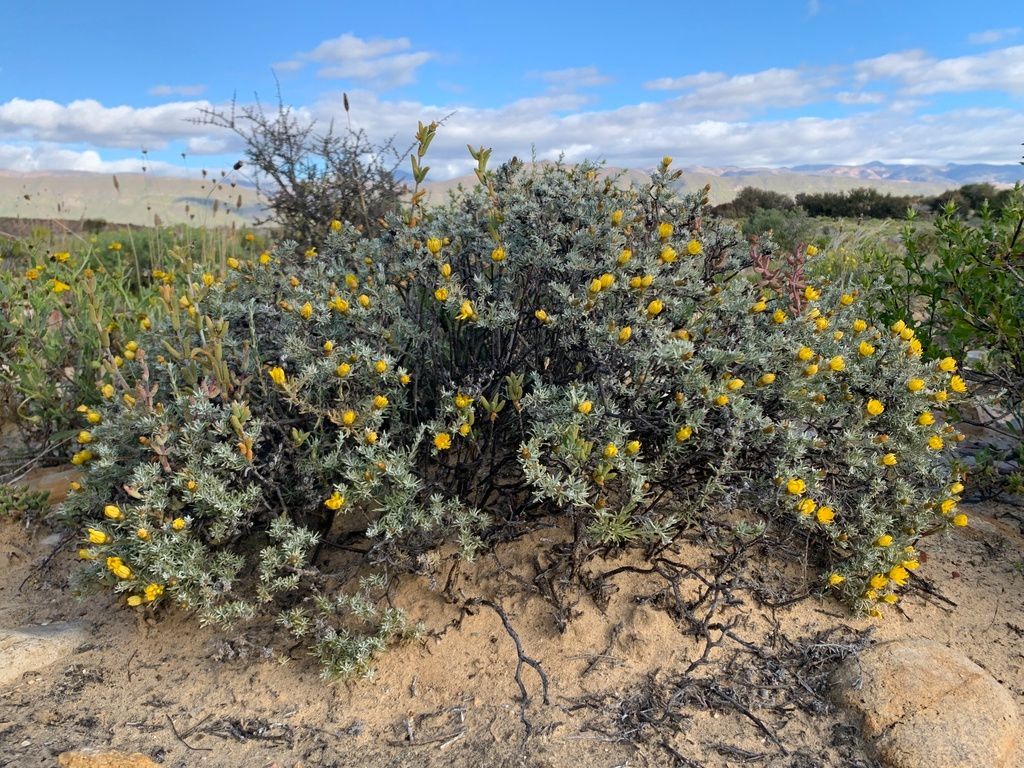
Hartbeeskaroo
Oedera humilis
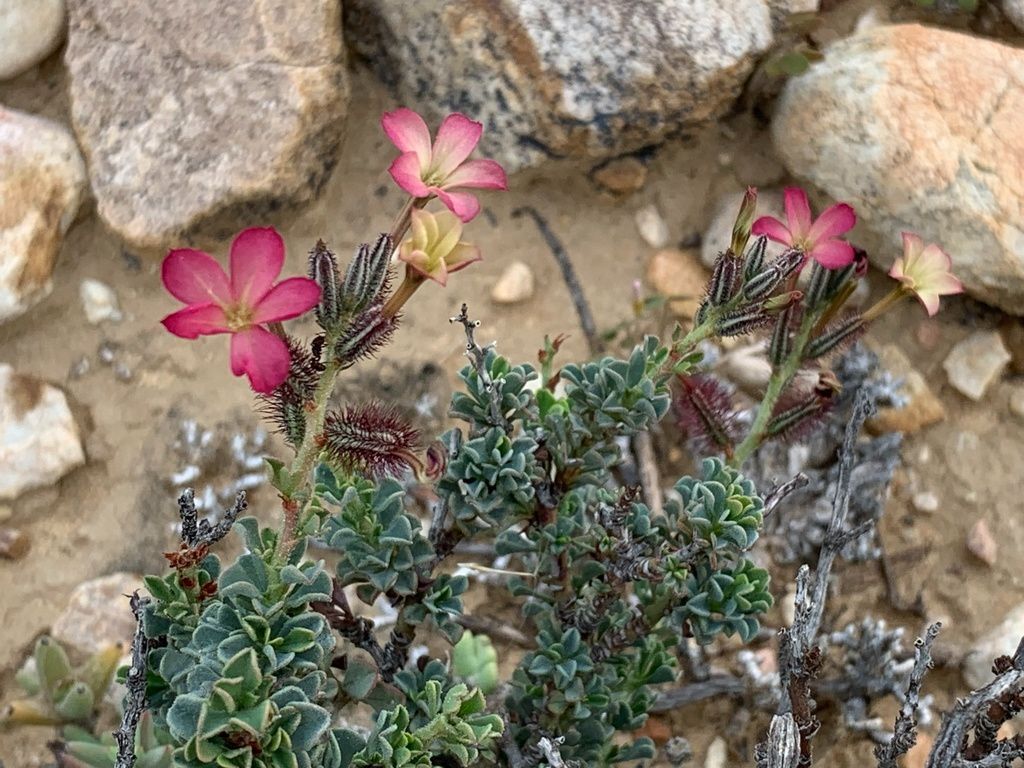
Vaalharthie
Plumbago tristis
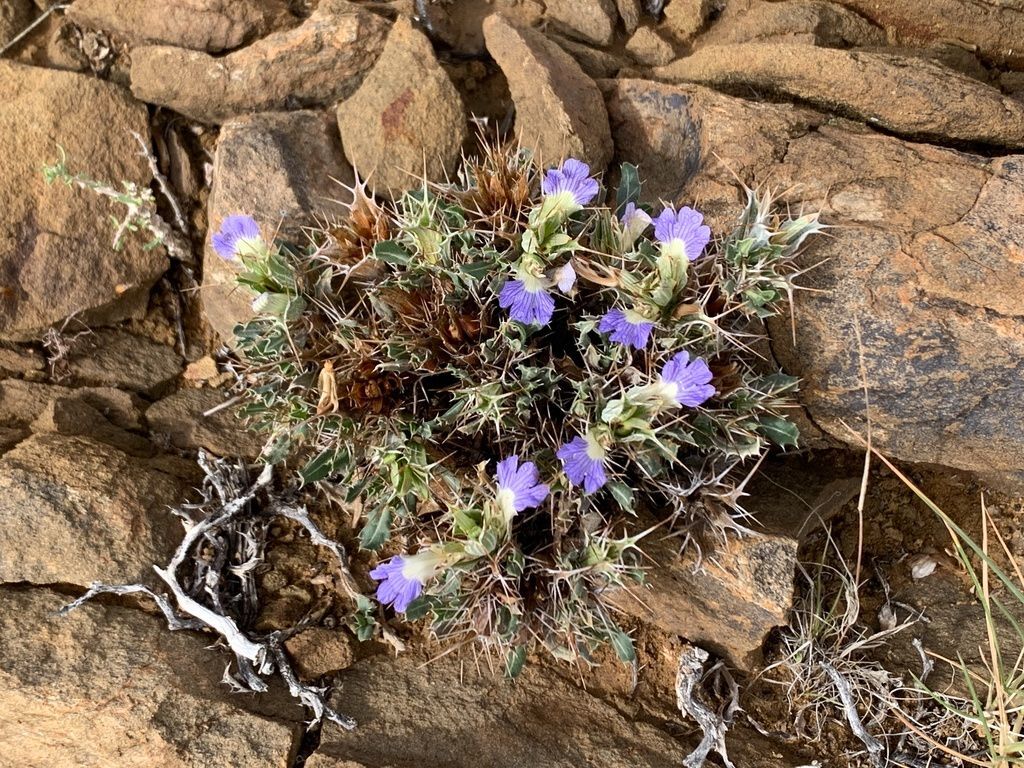
Skerpioenbos
Blepharis mitrata
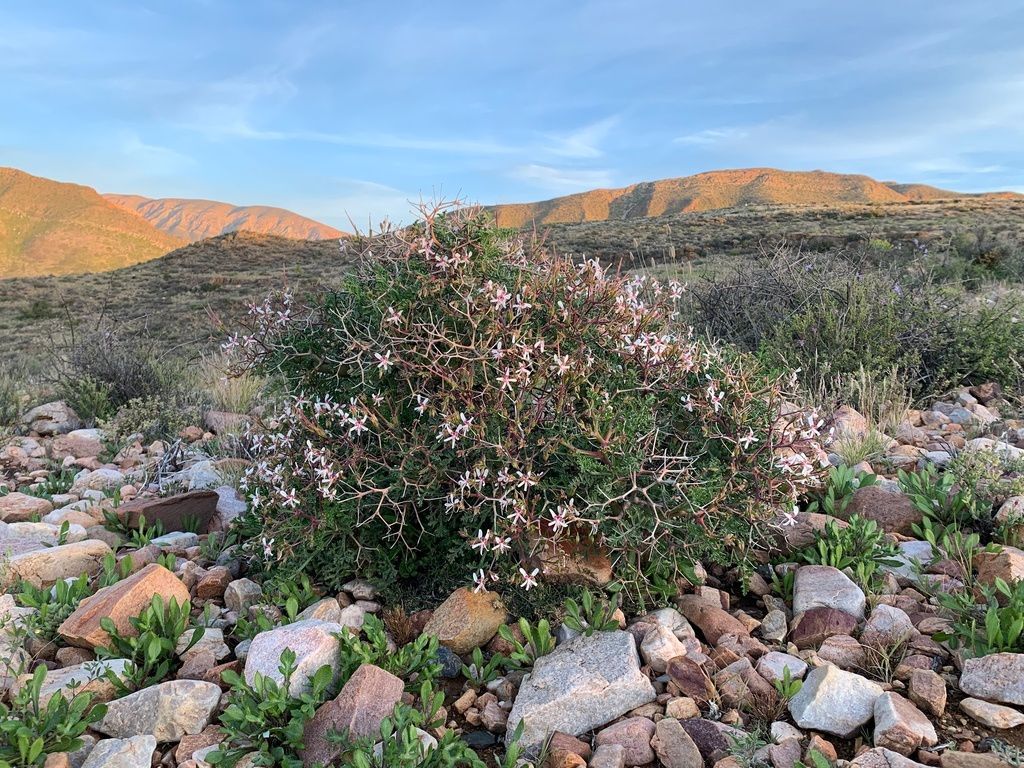
Dikbasmalva
Pelargonium chrithmifolium
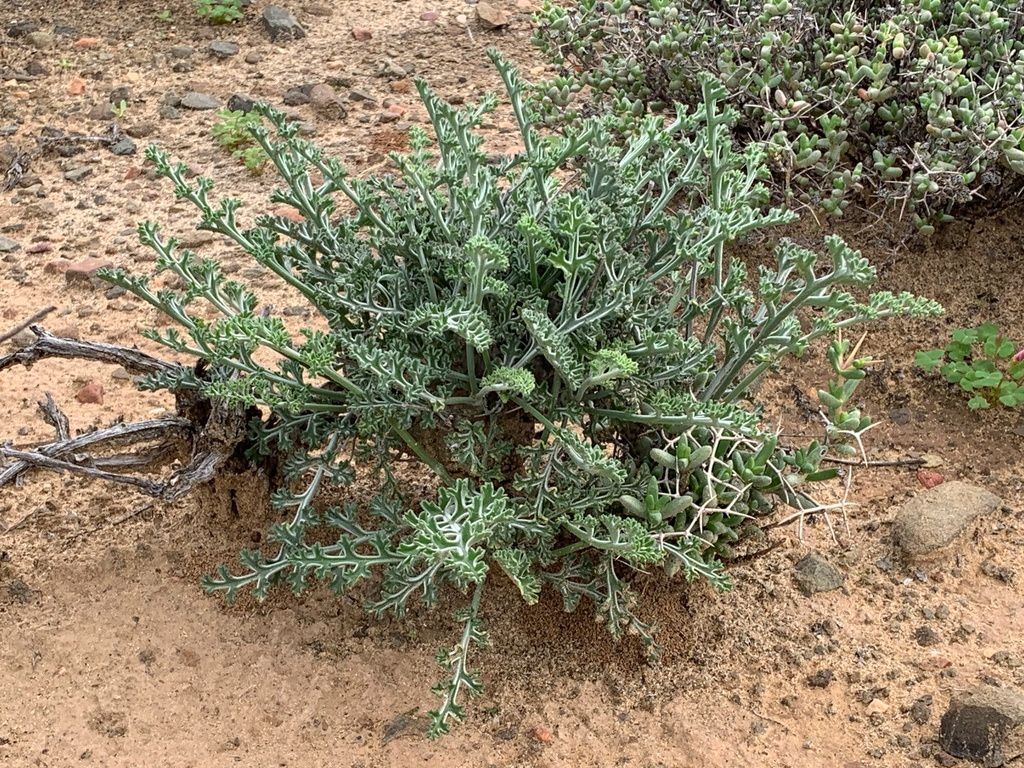
Oupa-aree
Pelargonium carnosum
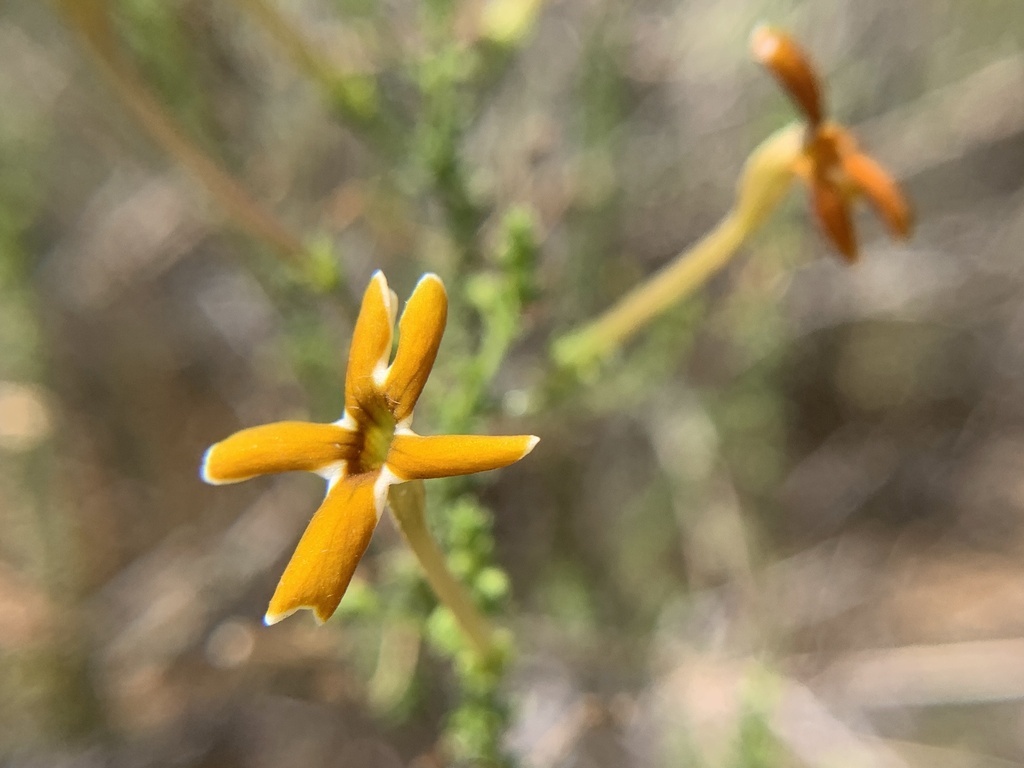
Saffraan
Jamesbrittenia atropurpurea
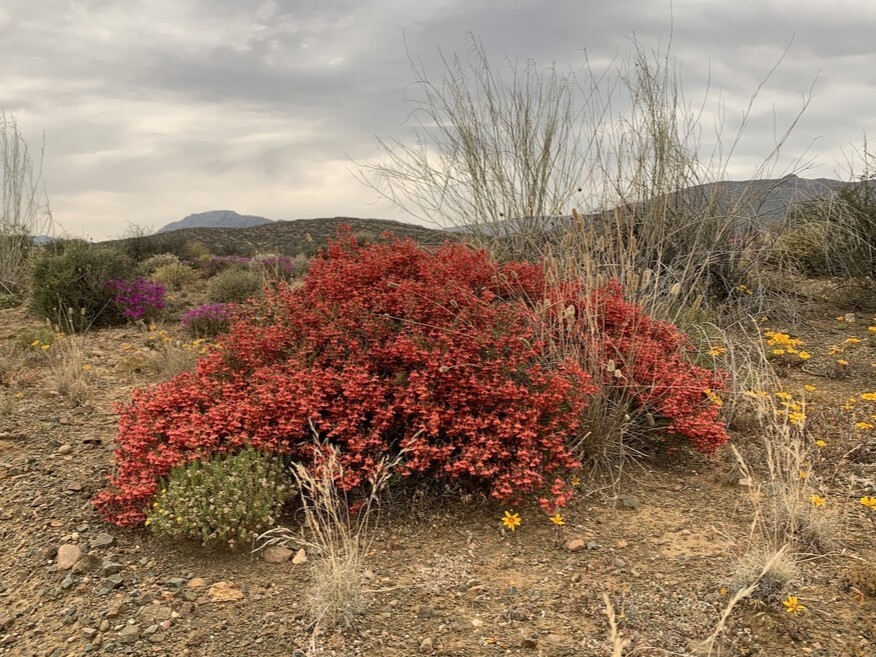
Ouma se kappie
Hermannia grandiflora
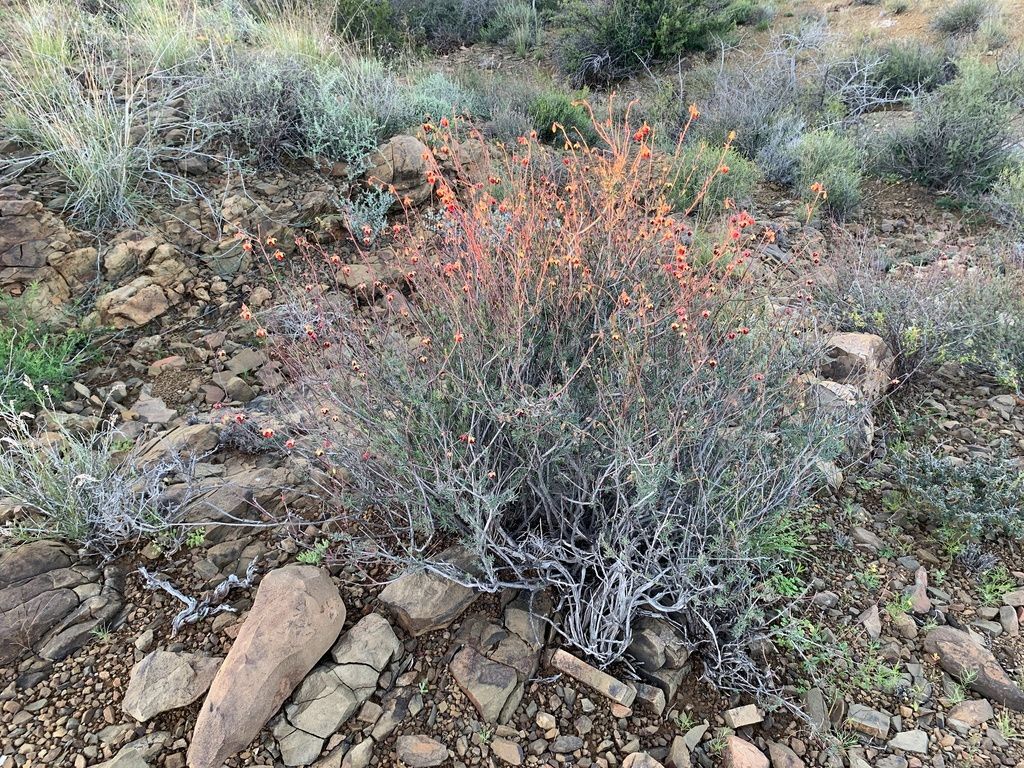
Poprosie
Hermannia filifolia
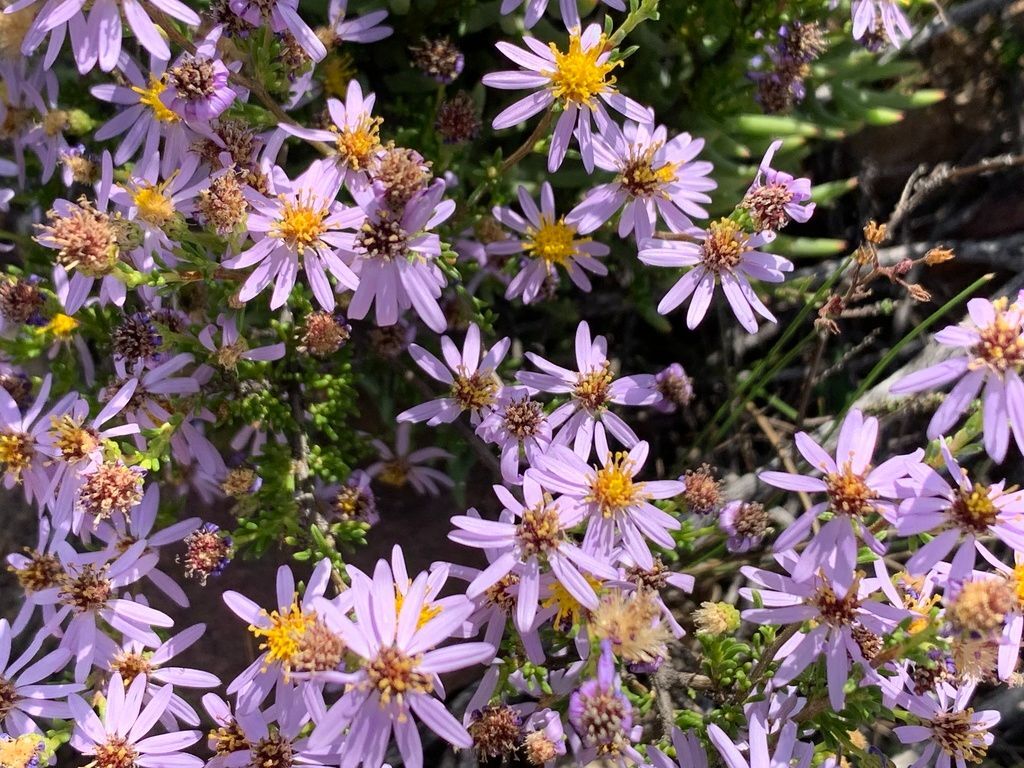
Draaibos
Felcia filifolia
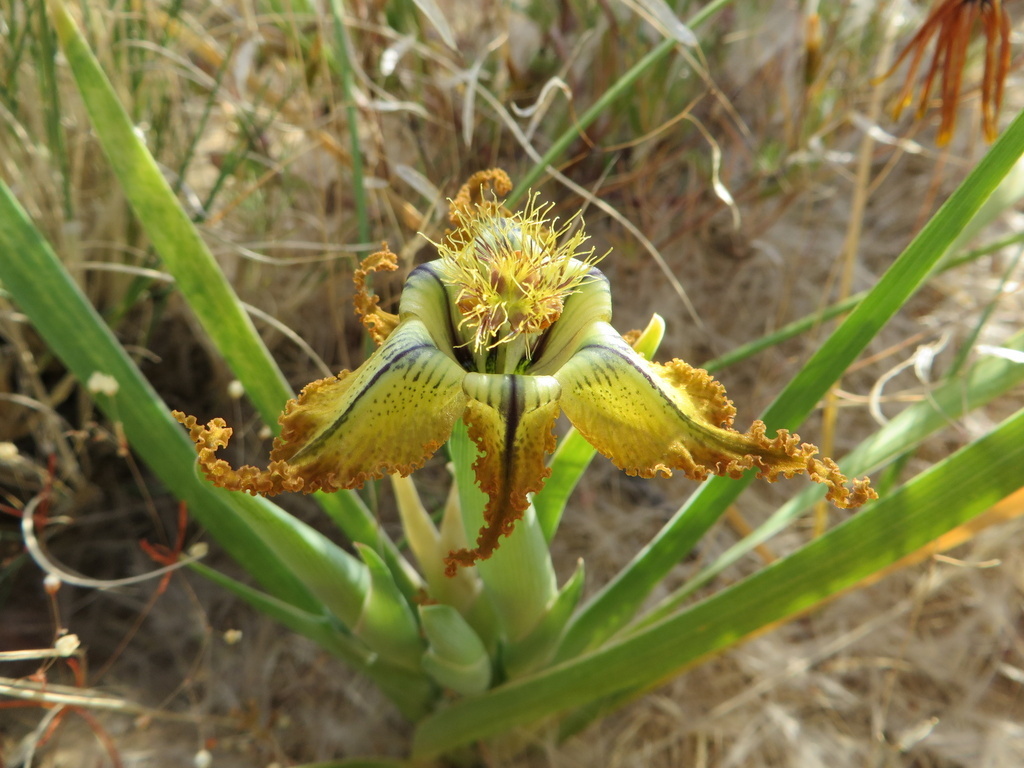
Gifuintjie / Spinnekopblom
Ferraria variabilis
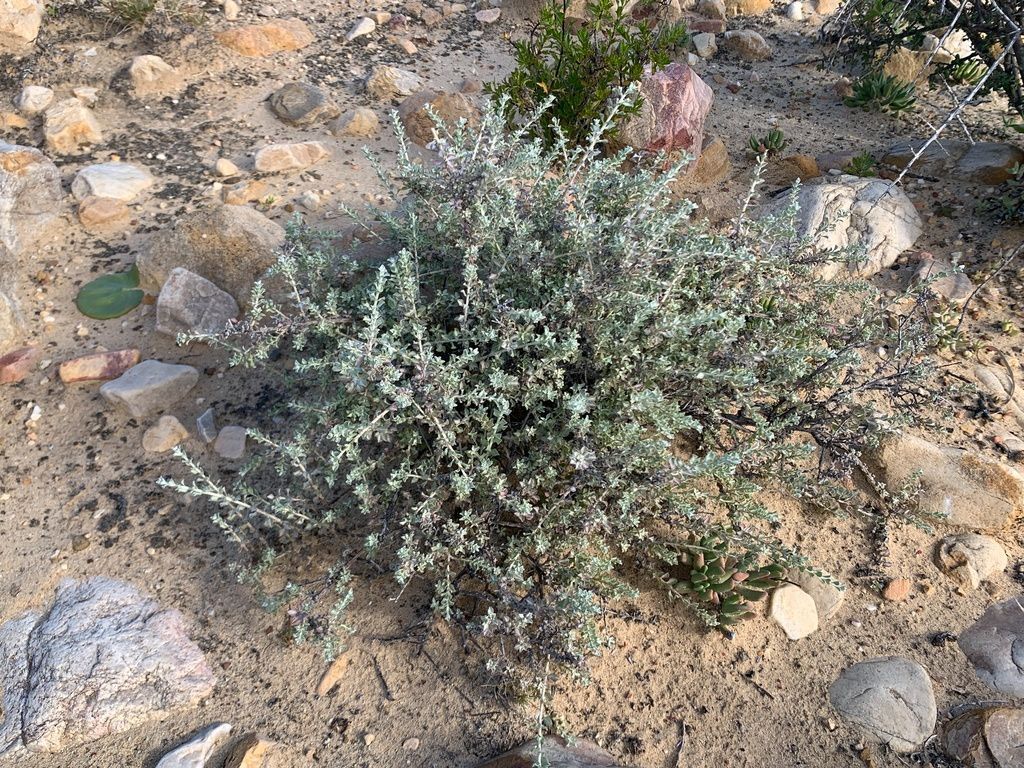
Bergkerrie
Helichrysum lucilioides
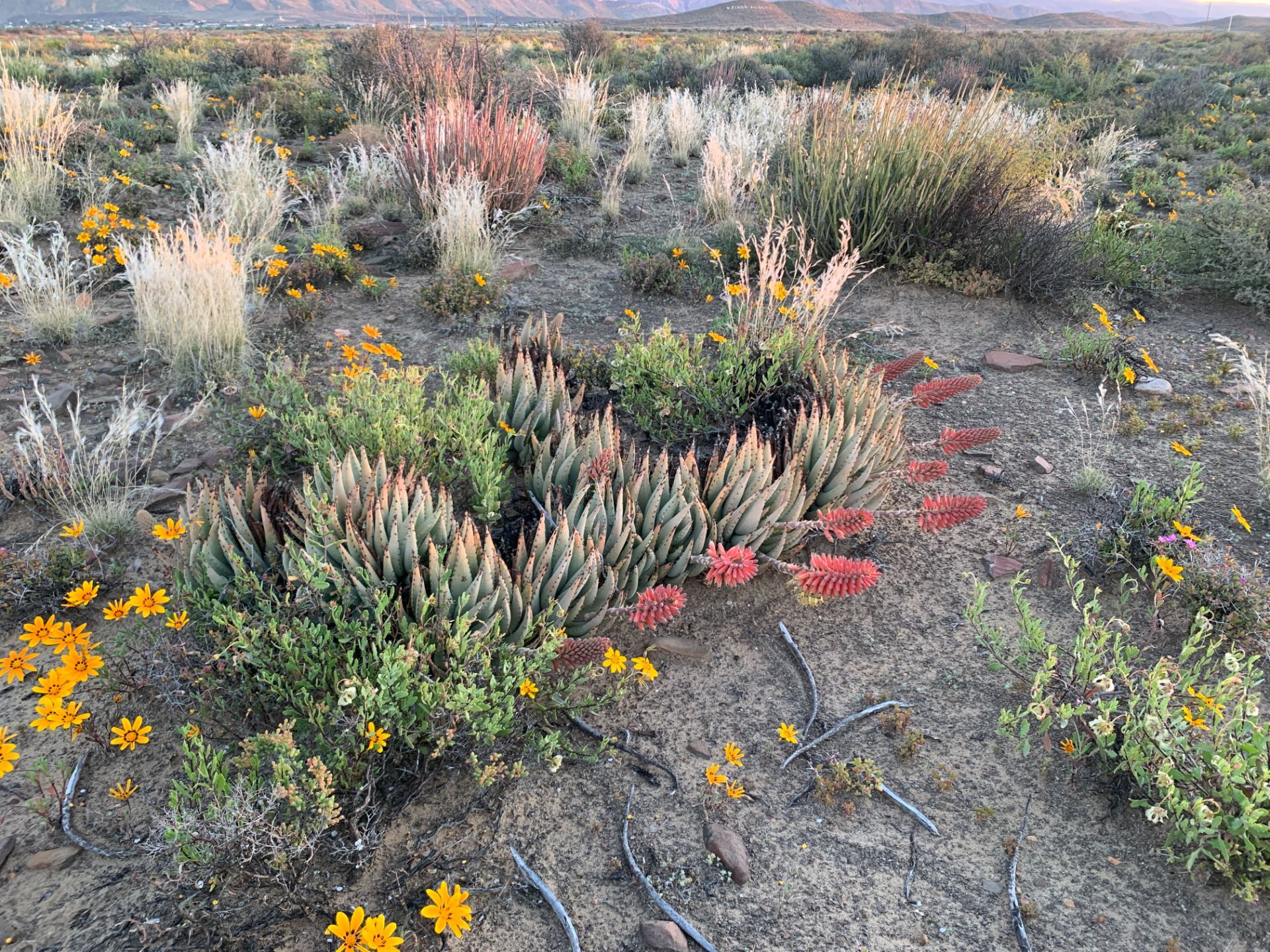
Kraal Aalwyn
Aloe claviflora
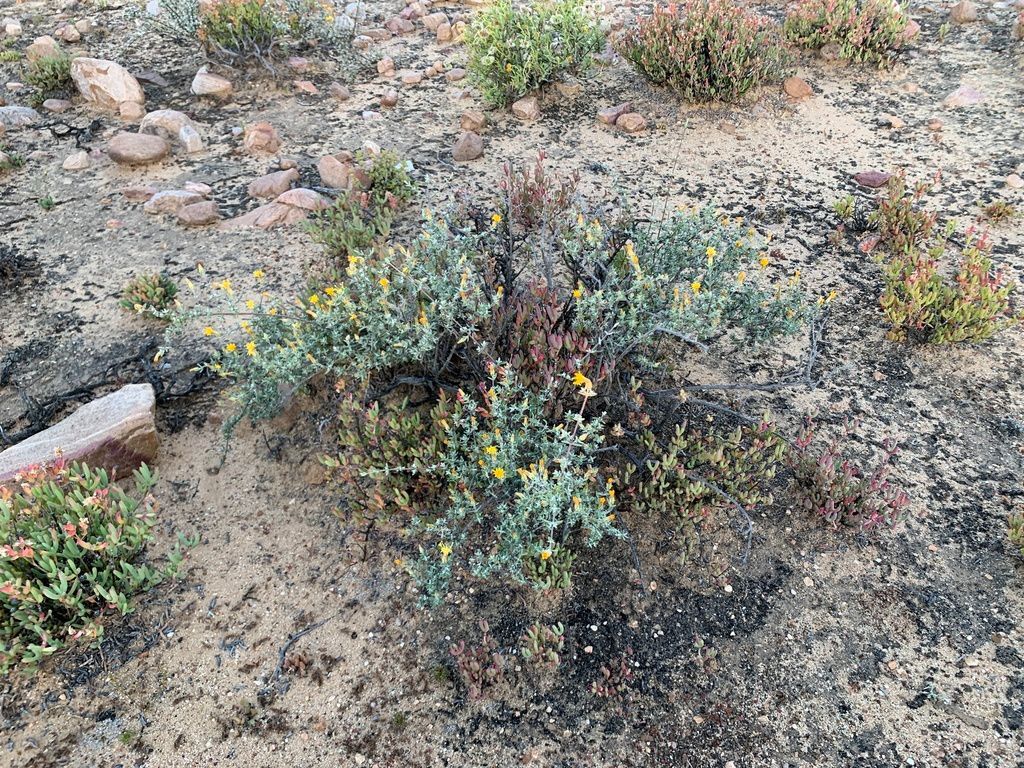
Boegoekaroo
Pteronia glauca
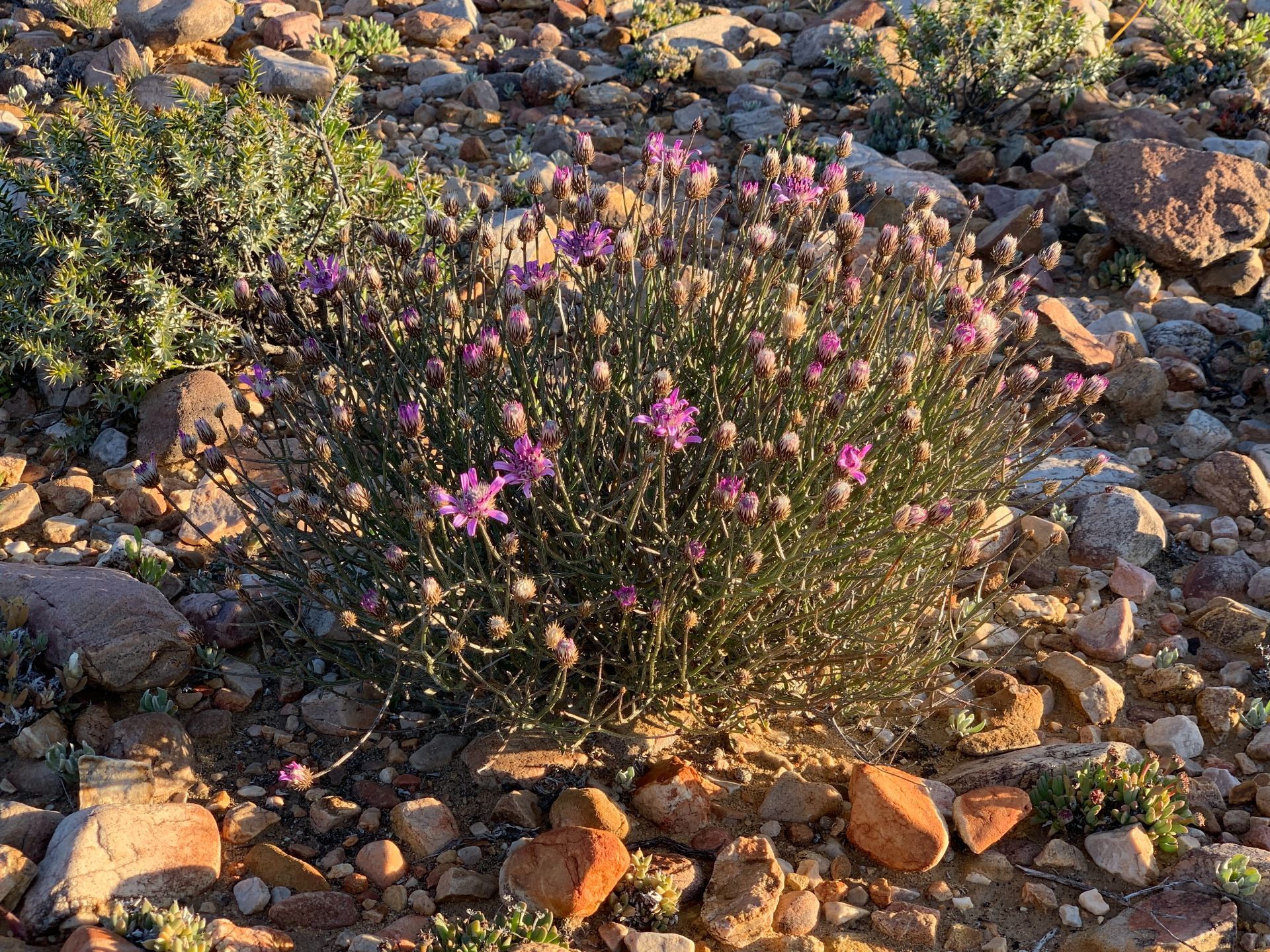
Knoppiesdoring Bossie
Dicoma picta
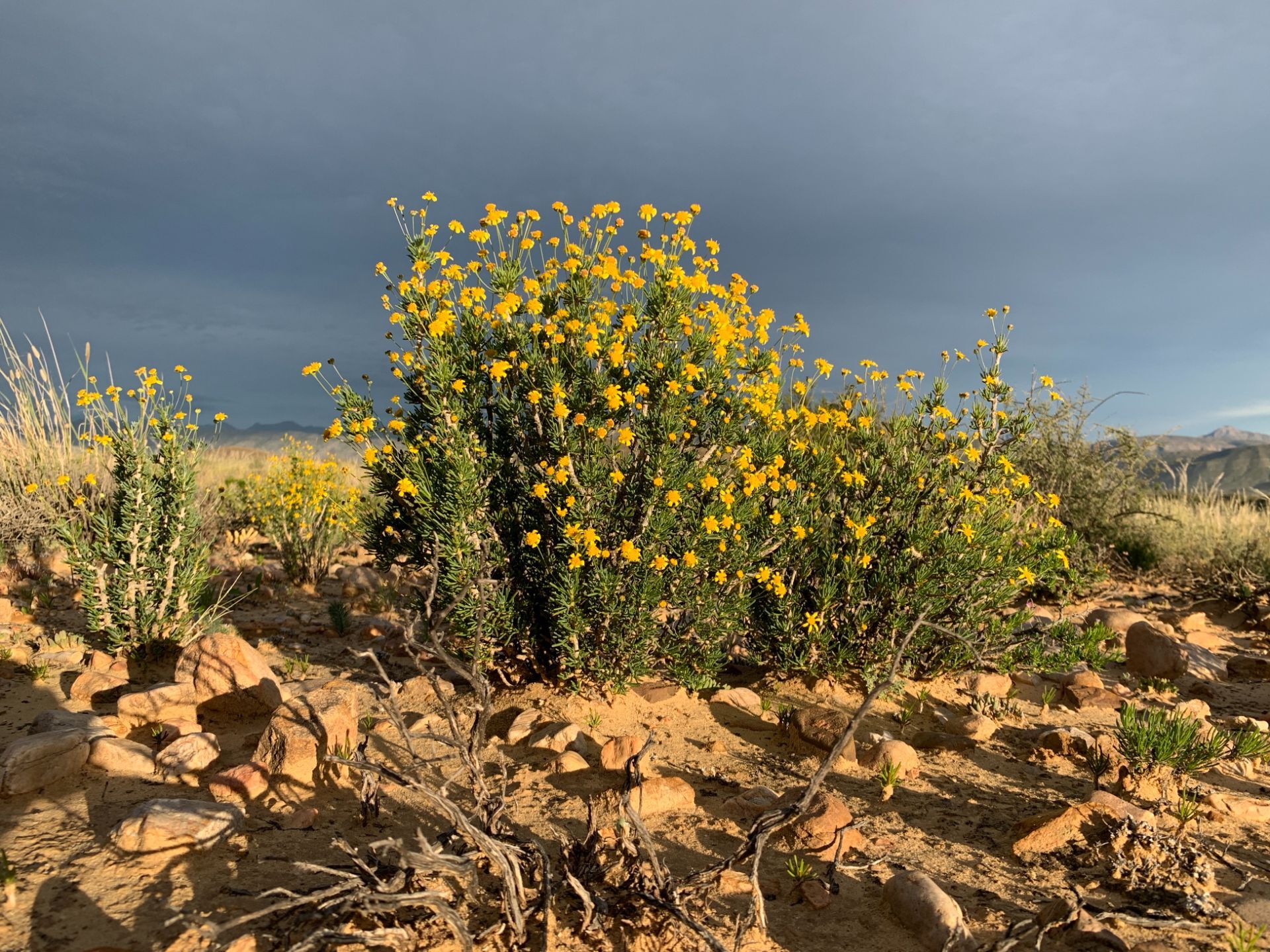
Soetharpuisbos
Euryops subcarnosus subsp. subcarnosus
Protected Area Expansion in Prince Albert
The Prince Albert Municipality has signed documents confirming its commitment to protecting the Gordon Koppie through a 10-year stewardship contract with CapeNature. The formal proclamation and hence the funding has been delayed by loss of the deeds for the properties owned by the Municipality.
The Karoo Gateway Conservancy is under consideration for protected status. This land to the north, east and west of Meiringspoort covers around 15,000 ha. Sue Dean will assist CapeNature with a biodiversity survey of the Succulent Karoo, Thicket and Renosterveld portions of this property from 2-4 September 2026.
Upcoming Events
Prince Albert Open Gardens is happening on 25-27 September 2026. Encouraging waterwise, sustainable gardening and garden biodiversity, this event shows unique Great Karoo gardens, a host of talks, walks, and workshops, including some guided walks on Wolwekraal Nature Reserve, and talks in our new Research and Education Centre:
Sue Dean: Vygies of the Prince Albert Succulent Karoo
Hinata Abe: Special Vygie of Prince Albert
Jan Vlok: Gardening in the Karoo
Karin Sternberg: Looking for Bees with a Gaze Groundwards
Brett Bard: Applied Zoopharmacognosy
John Carlyon: Birds of the Karoo and Prince Albert Gardens
Bertus Fourie and Lindy Van Hasselt: Pioneering Bare and Compacted Old Lands
John Carlyon: The Karoo Night Sky
Sue Torrance: The Power of the Humble Seed
Wolwekraal Biodiversity Walk with Sue Dean
Creatures of the Night - Bat and Scorpion Walk with Collette Hurt
Gordon Koppie Walk with Collette Hurt
Swartberg Pass Wild Walk with Sue Dean
We are grateful for the support we get from Prince Albert Open Gardens, and a percentage of their ticket sales goes towards our conservation efforts on the reserve.
For an exciting program, and to book tickets, visit the website here:
Forthcoming Talks at the WCRT Research and Education Centre:
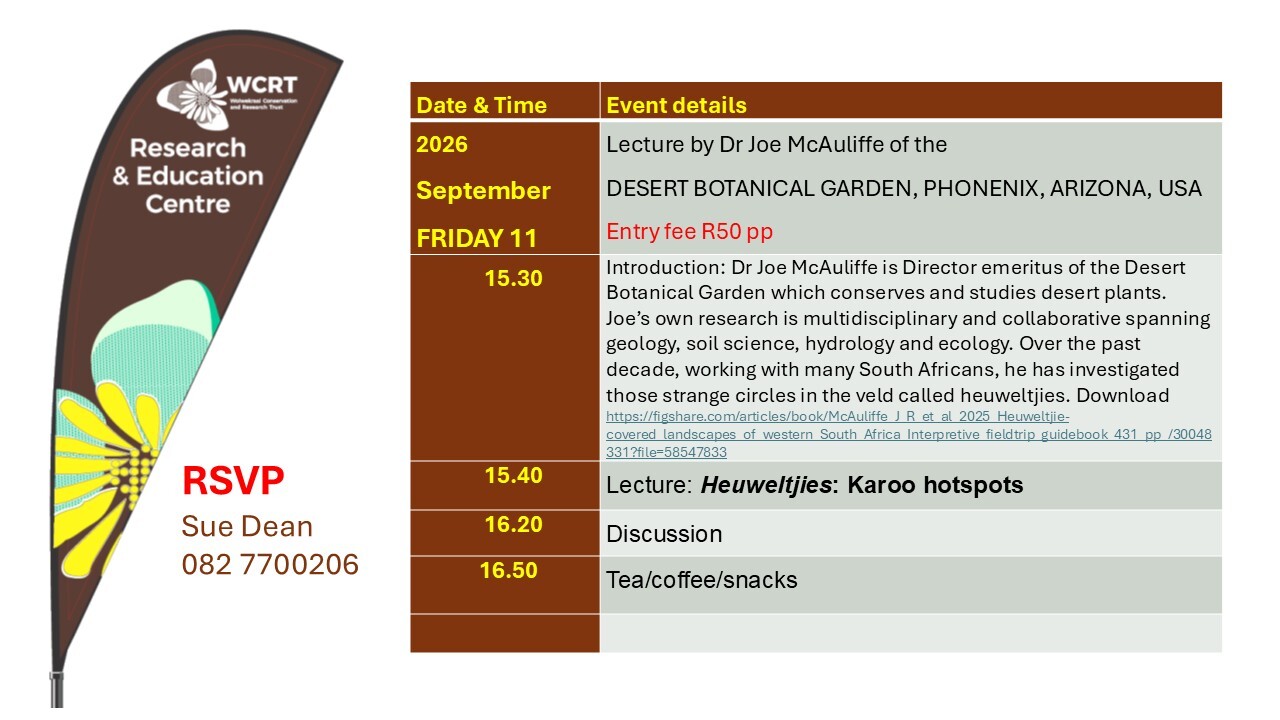
11 September 2026
Heuweltjies (Prof Joe McAuliffe of the Sonoron Desert Botanical Garden, USA)
25 Spetember 2026
Open Gardens Talks (See above)
17 October 2026
Careers in Conservation – a special talk for school leavers (Willem Matthee, NMU)
14 November 2026
GCBR strategy: the Need for Conservation Volunteers (Linda Fletcher, GCBR)
11 December 2026
Assessment of the Success of Ecological Restoration (Chrizette Neethling, Endemic Vision)
Get Involved
Wolwekraal Nature Reserve relies on an income generated from guided nature walks on the reserve, as well as public support and donations to cover annual running costs and ongoing conservation efforts. By supporting conservation on Wolwekraal Nature Reserve, you can help ensure the long-term survival of species and their habitats. Contributions will fund habitat protection, species monitoring and research, restoration of damaged Karoo habitats, anti-poaching and conservation efforts, general reserve operations, trail maintenance, and education and outreach projects.
Every contribution, big or small, strengthens our conservation work. For more details, visit the Support page on our website:
Thank you for standing with us, sharing our work, and helping us protect this precious piece of the Karoo. Until next time, stay curious and keep exploring the veld!
With gratitude,
Wolwekraal Conservation and Research Organisation